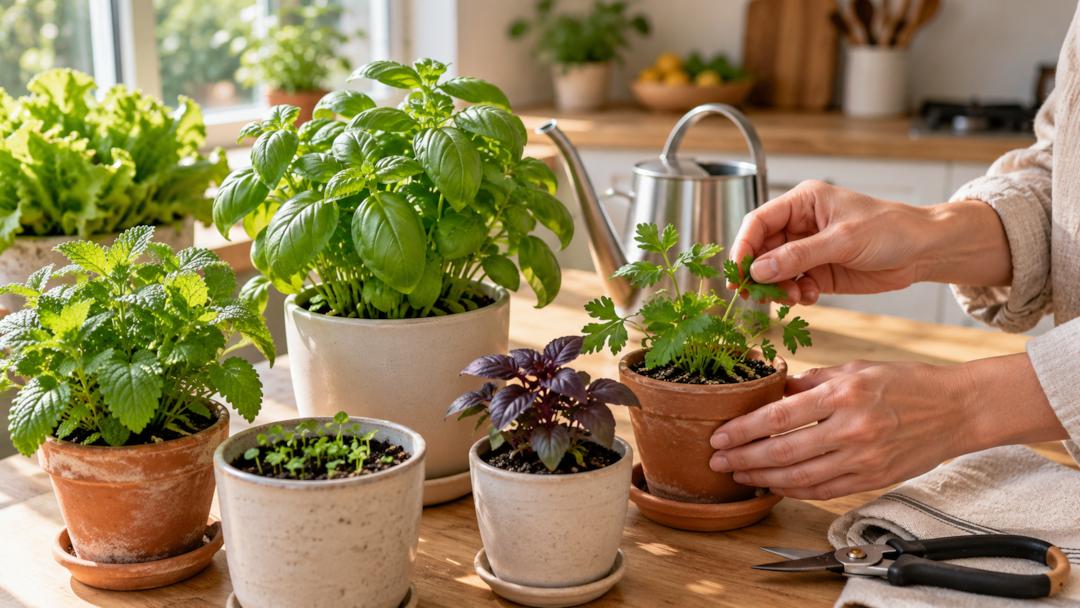
Waiting for your indoor herbs to grow can be frustrating. You plant your seeds, provide water and nutrients, and check your garden every day—but weeks later, your basil still looks small, your parsley has only a few leaves, and your lemon balm seems to be taking forever to fill out.
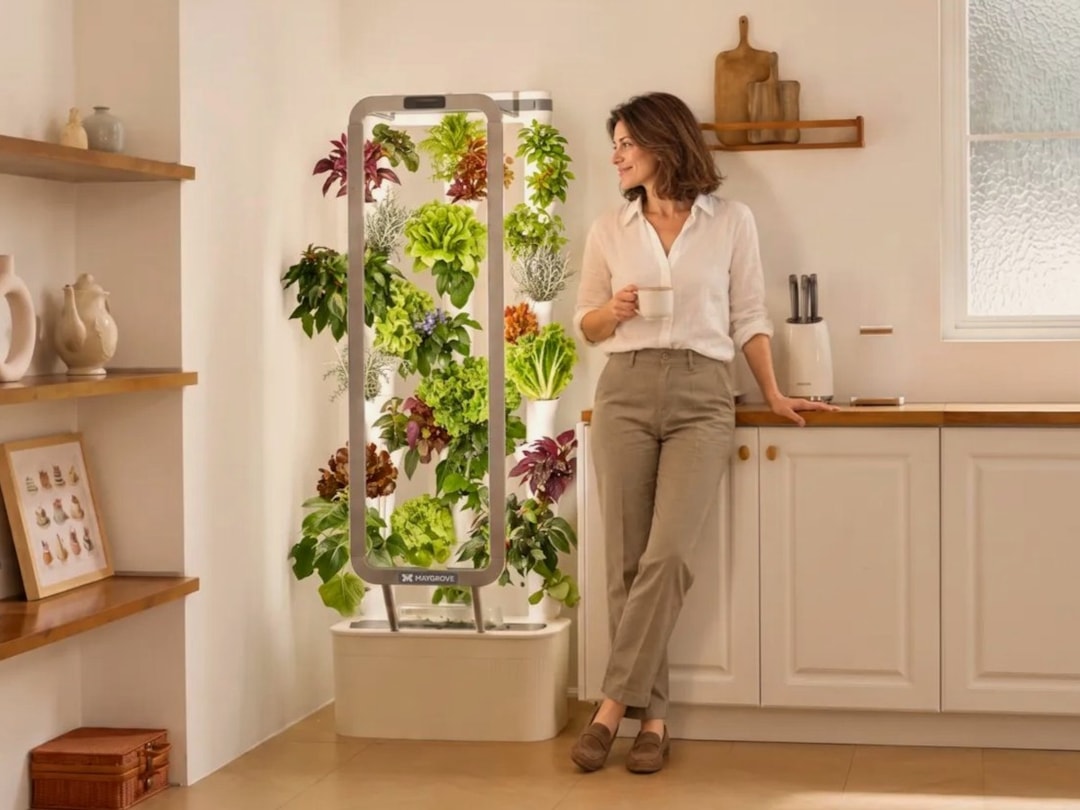
Before assuming something is wrong, remember this: different plants grow at different rates, and not every herb follows the same timeline from seed to harvest.
Many leafy greens, such as lettuce, can produce harvestable leaves relatively quickly. Herbs often need more time to germinate, establish their roots, and develop enough foliage for regular harvesting. Even within the same plant family, varieties can differ in growth habit, leaf size, and time to maturity.
However, slow growth can also signal a problem. Insufficient light, unsuitable temperatures, poor root development, nutrient imbalances, and overcrowding can all affect how quickly indoor herbs develop.
Understanding your plant's normal growth timeline is the first step toward deciding whether it simply needs more time or whether something needs to change.
How Long Do Indoor Herbs Take to Grow?
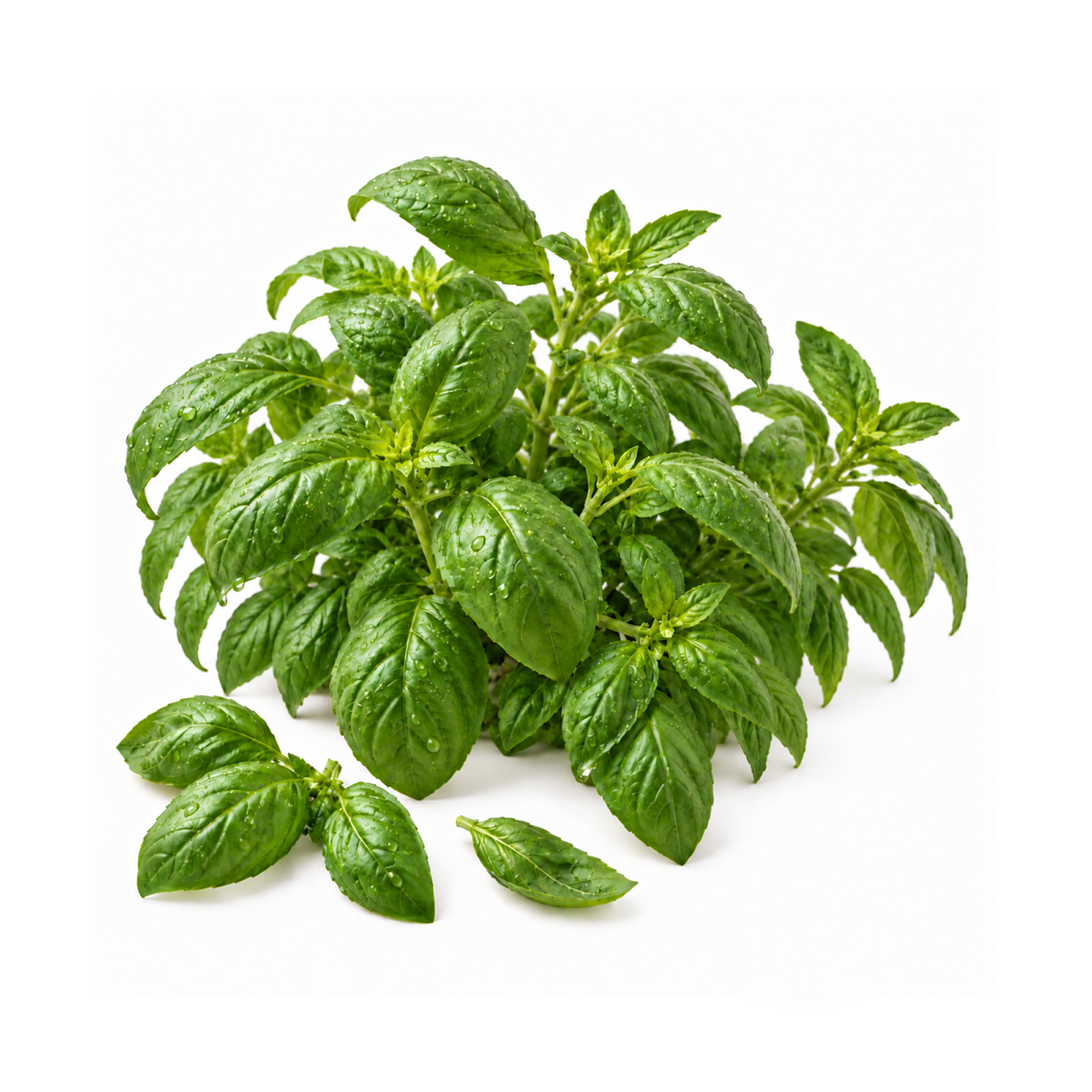
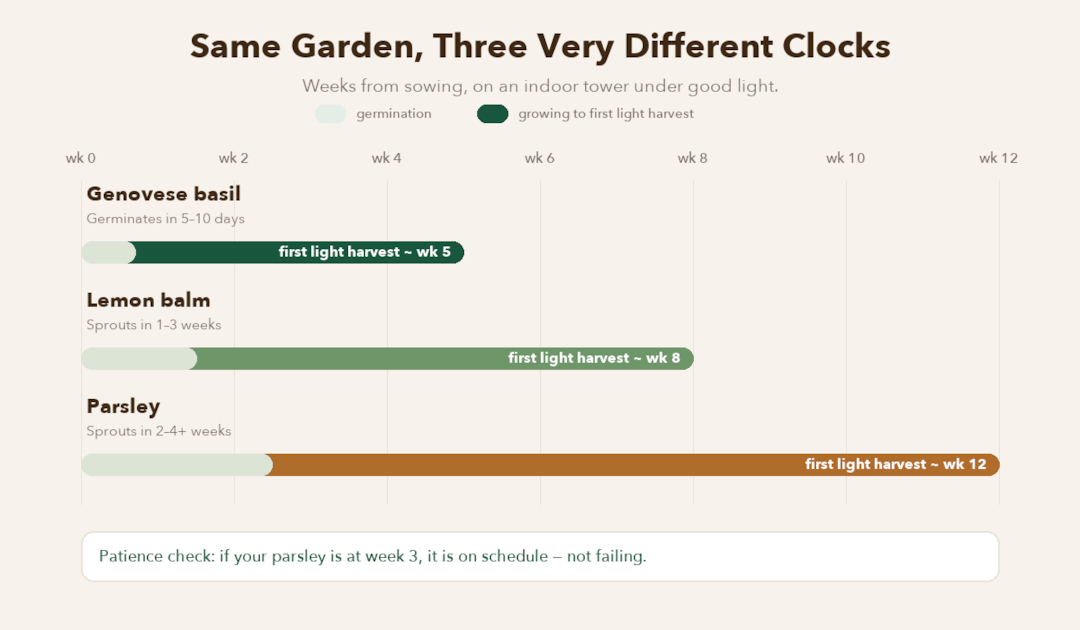
There is no single growth timeline for all herbs. Some basil varieties can provide their first small harvest within several weeks, while parsley often takes longer to germinate and establish. Perennial herbs such as lemon balm can continue producing leaves over an extended period once established.
The table below provides approximate planning ranges for indoor growing. Actual timing depends on the cultivar, seed quality, growing conditions, and what you consider a harvestable plant.
Indoor Herb Growth and Harvest Timeline
| Herb | Typical Seed Germination Time | Approximate First Light Harvest | Growth Habit | Recommended Harvest Type |
|---|---|---|---|---|
| Genovese Basil | About 5–10 days under suitable conditions | Around 4–6 weeks after sowing for a small harvest | Relatively fast-growing in warm, bright conditions | Pinch or cut stem tips above a leaf pair to encourage branching |
| Lemon Basil | Often about 5–14 days, depending on conditions | Approximately 4–8 weeks after sowing | Similar to other culinary basils, with cultivar-dependent growth | Harvest individual leaves or pinch stem tips |
| Red Rubin Basil | Often about 5–14 days, depending on conditions | Approximately 4–8 weeks after sowing | Purple-leaved basil; growth rate varies by cultivar and environment | Harvest leaves and stem tips while maintaining enough foliage for continued growth |
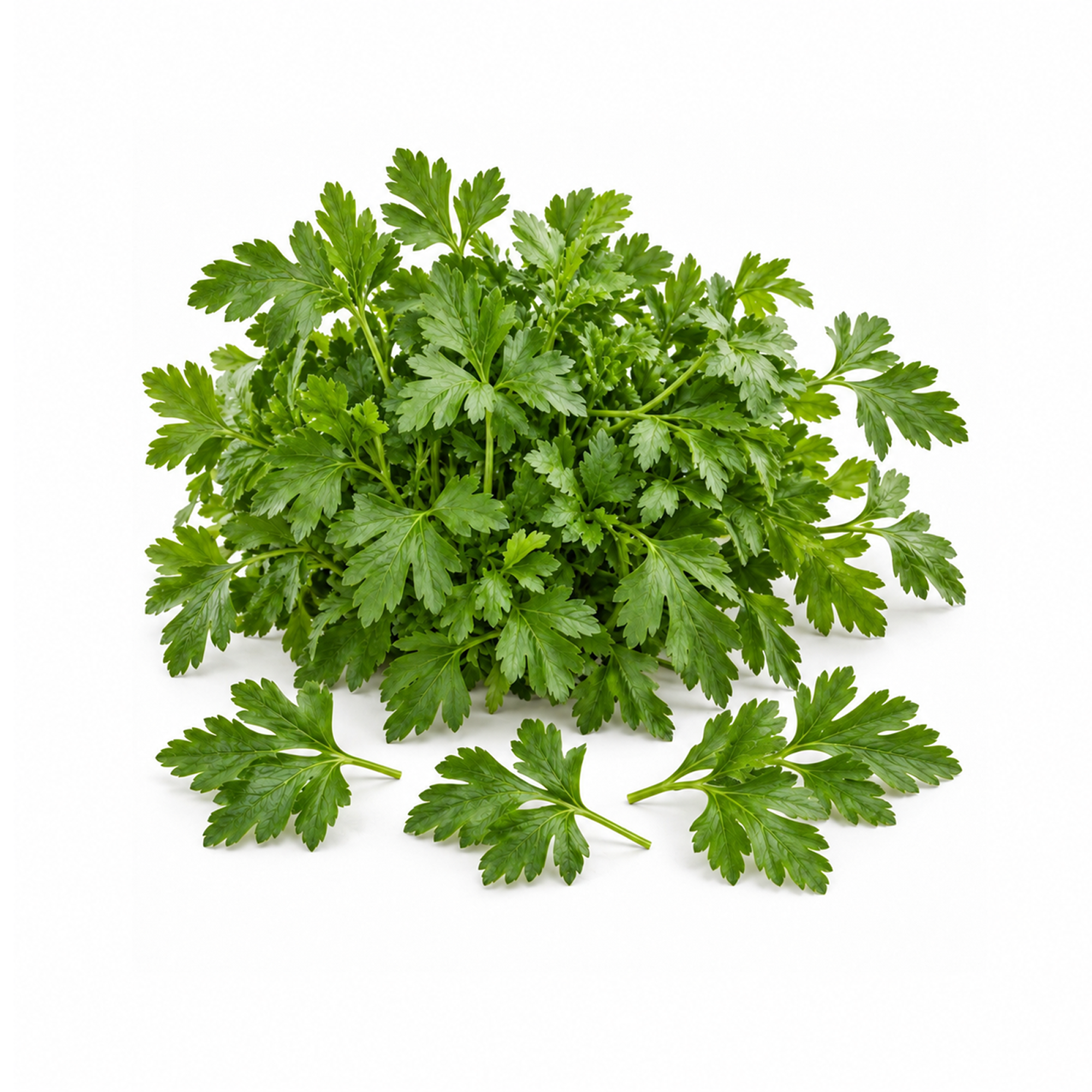
| Italian Flat Leaf Parsley | Often around 2–4 weeks, sometimes longer | Approximately 8–12 weeks or longer after sowing for a useful harvest | Relatively slow to establish from seed | Harvest mature outer leaves from the base of the plant |
| Dark Green Parsley | Often around 2–4 weeks, sometimes longer | Approximately 8–12 weeks or longer after sowing for a useful harvest | Establishment can be slow; leaf production improves as the plant matures | Harvest mature outer leaves, leaving the central growing point intact |
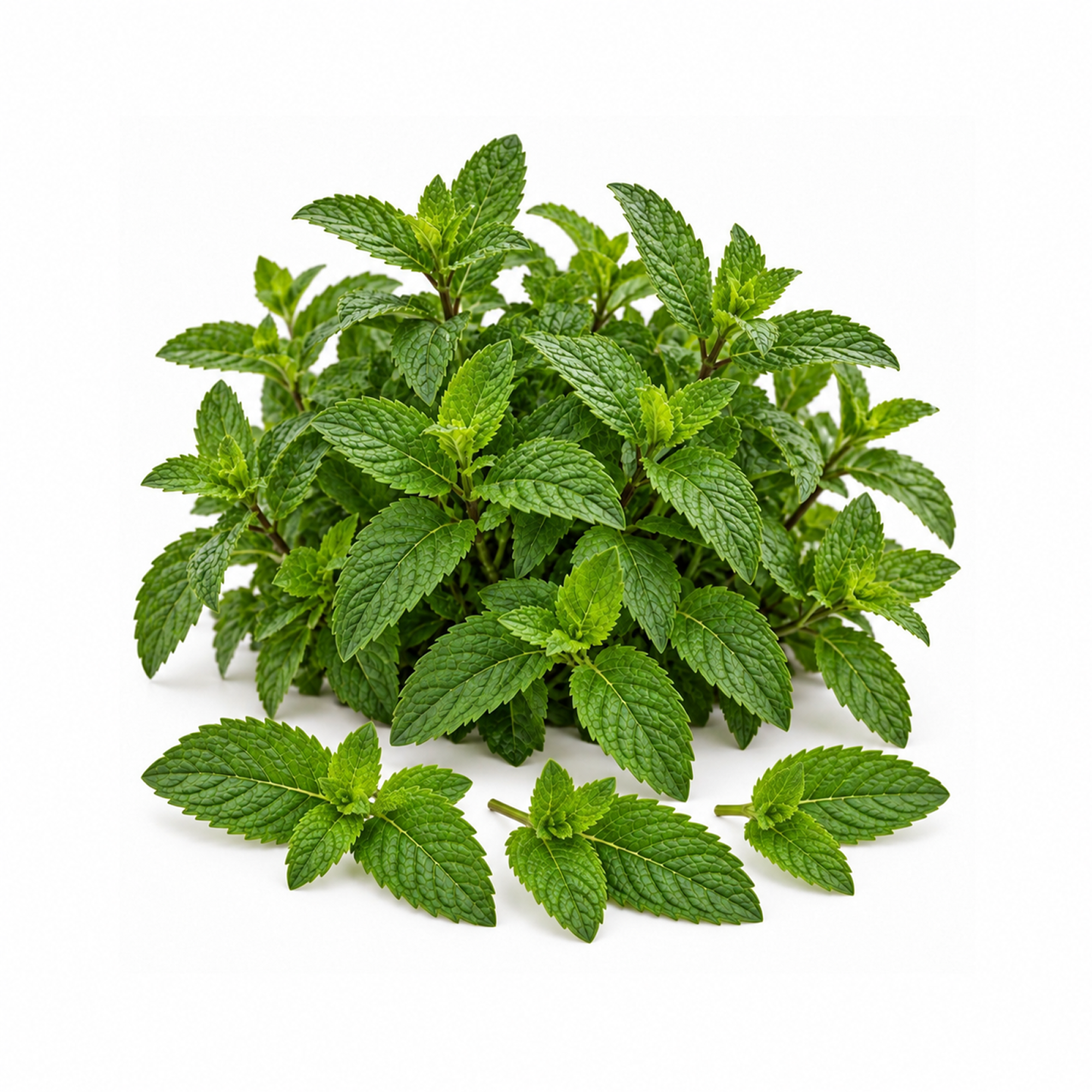
| Lemon Balm | Often around 1–3 weeks, but germination can be variable | Approximately 6–10 weeks or longer after sowing for a light harvest | Perennial herb that can become bushy as it establishes | Pinch or cut leafy stems to encourage branching |
| Catnip | Often around 7–14 days under suitable conditions | Approximately 6–10 weeks or longer after sowing for a light harvest | Perennial herb that develops into a leafy plant as it matures | Harvest leafy stems or individual leaves once the plant is established |
Important: These are approximate planning estimates, not guaranteed harvest dates or cultivar-specific specifications. Some varieties take longer, and plants grown under limited indoor light may develop more slowly. Follow the growing guidance provided with your specific seeds or growing system.
The timelines also describe different milestones. Germination means a seed has sprouted; first harvest means the plant has developed enough usable foliage to tolerate some harvesting. Neither necessarily means the plant has reached full maturity.
Why Does Lettuce Often Grow Faster Than Herbs?
Many lettuce varieties develop harvestable leaves relatively quickly. Under suitable conditions, baby lettuce leaves may be ready for harvesting within a few weeks, while larger plants take longer.
Herbs have different growth patterns.
- Basil can develop quickly when temperatures and lighting are suitable, but it needs enough branching and foliage to support repeated harvesting.
- Parsley often takes longer to germinate, so it may appear inactive before its seedlings even emerge.
- Lemon balm and catnip are perennial herbs. They need time to establish, even though they can continue producing foliage over a longer period.
- Different basil varieties can vary in vigor, leaf size, and branching, so their timelines are not always identical.
A faster-growing crop is not necessarily a better crop. The right choice depends on what you want to harvest, how often you use it, and how much time you're willing to allow for plant development. If you want the quick-win version of this story, growing romaine lettuce indoors shows what a fast crop looks like from seed to bowl.
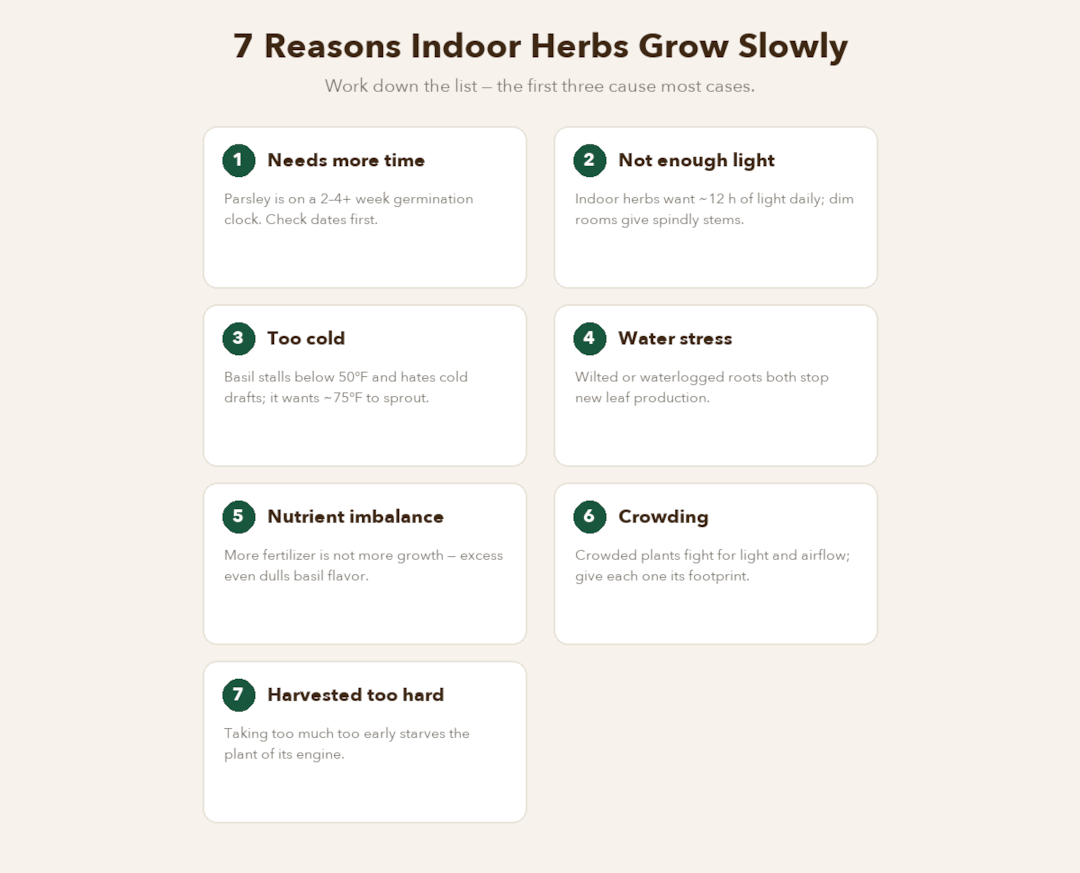
7 Common Reasons Your Indoor Herbs Are Growing Slowly
If your herbs are taking longer than expected, start by comparing their progress with the normal growth timeline for that species. Then investigate the growing conditions.
1. Your Herbs Simply Need More Time
This is particularly important when growing parsley.
Parsley seeds are known for relatively slow and sometimes uneven germination. University of Wisconsin–Madison Extension puts it plainly: even under optimum conditions, parsley seed germination is erratic and low — and soaking the seeds overnight helps. If you planted parsley a week ago and haven't seen seedlings, that alone does not mean the seeds have failed.
Basil generally germinates faster under suitable warm conditions, while lemon balm and catnip can also show variation in emergence.
What to do:
- Check how long the seeds have been planted.
- Confirm that the growing medium or seed-starting environment is appropriate for the crop.
- Maintain the moisture and temperature recommended for germination.
- Avoid repeatedly disturbing seeds to check whether they have sprouted.
If a crop is still within its expected germination window, patience may be the best response — that is the whole point of the timeline chart above.
If it has remained dormant well beyond the usual range, investigate seed quality, moisture, temperature, and planting depth before starting over.
2. Your Grow Lights Are Not Providing Enough Usable Light
Insufficient light is one of the most common reasons indoor herbs develop slowly.
A plant may survive in a dim room, but survival is not the same as productive growth. Herbs that receive too little light may produce small leaves, elongated stems, widely spaced leaves, and weak overall growth.
Basil, in particular, generally benefits from bright light and warm growing conditions. Lemon balm may tolerate lower light better than some herbs, but its growth can still be limited when light is insufficient.
What to do:
- Check the recommended light requirements for each herb.
- Confirm that the plants receive adequate light intensity, not just a long lighting period.
- Make sure the light reaches the growing canopy evenly.
- Follow the recommended distance between the light and the plants.
- Keep a consistent daily lighting schedule.
Extending the lighting period is not always the answer. A weak light source running for many hours may still fail to provide enough light for vigorous growth. University of Minnesota Extension gives concrete targets: indoor herbs need about 12 hours of artificial light daily, and seedlings starting under lights do best with 14–16 hours for compact, sturdy growth — inadequate light shows up as thin, spindly stems. If your basil is already stretched and floppy rather than just small, that is the leggy pattern — why basil gets tall and leggy covers how to fix it.
If you are using an indoor growing system, follow its lighting instructions and crop-specific recommendations.
3. The Temperature Is Not Suitable for Your Herbs
Different herbs have different temperature preferences.
Basil is particularly sensitive to cold conditions. Iowa State University Extension recommends about 75°F for germination and warns that basil does not tolerate cold — seedlings sown outdoors should wait until nights stay consistently above 50°F. Indoors, a basil plant near a drafty window in winter can sit in that danger zone without you noticing. Cold exposure can also damage basil leaves directly.
Parsley generally tolerates cooler conditions better than basil, while lemon balm and catnip have their own environmental preferences.
An indoor garden placed near a cold window, an air-conditioning vent, or a drafty door may experience temperature fluctuations even when the room feels comfortable.
What to do:
- Check the temperature near the plants rather than relying only on the thermostat across the room.
- Avoid exposing temperature-sensitive herbs to cold drafts.
- Follow the temperature recommendations for the specific crop.
- Look for patterns between temperature changes and periods of slow growth.
Don't assume that every herb grows best at the same temperature. UMN Extension groups them usefully: parsley, chives, cilantro, and dill are cool-season herbs, while basil, rosemary, lavender, and oregano are warm-season herbs that prefer noticeably warmer conditions. If you are growing several varieties together, their requirements should be reasonably compatible.
4. Your Plants Are Not Receiving the Right Amount of Water
Both underwatering and overwatering can slow herb growth.
When plants do not receive enough water, they may wilt, develop dry leaf edges, or stop producing new leaves. When roots remain excessively wet and poorly aerated, they may become damaged, limiting the plant's ability to absorb water and nutrients.
The right watering approach depends on the growing system.
Herbs growing in potting mix need a balance between moisture and drainage. In a hydroponic system, root-zone conditions, water circulation, and nutrient-solution management become especially important.
What to do:
- Check the growing medium or root-zone conditions rather than watering automatically.
- Make sure containers drain appropriately when growing in soil or potting mix.
- In hydroponic systems, follow the manufacturer's guidance for water levels and root care.
- Look for root discoloration, unpleasant odors, or other signs of root stress.
- Avoid making repeated water adjustments without identifying the likely problem.
Healthy roots are essential for healthy foliage. If roots are struggling, adding more light or fertilizer may not solve the underlying issue.
5. Nutrient Levels Are Not Appropriate
Indoor herbs need nutrients to develop leaves, stems, and roots. However, providing more fertilizer does not automatically make plants grow faster.
Too little nutrition can limit growth, while excessive fertilizer or an unsuitable nutrient balance can damage roots and interfere with nutrient uptake.
In hydroponic systems, plant growth may be affected by nutrient concentration, pH, water quality, and the condition of the root zone.
What to do:
- Follow the nutrient recommendations for your growing system and crop.
- Avoid adding extra fertilizer simply because growth seems slow.
- If your system provides pH or nutrient monitoring, review those readings according to its instructions.
- Consider whether root health or water conditions could be preventing nutrient uptake.
Leaf color can provide clues, but it is not a definitive diagnosis. Pale leaves, yellowing, and slow growth can result from several different problems.
For example, yellow leaves may indicate a nutrient issue, but they can also appear when roots are damaged or watering conditions are unsuitable.
Identify the likely cause before changing the nutrient supply. There is even a flavor argument for restraint: UMN Extension notes that rich, over-fertilized growth comes at the cost of essential oil production — meaning lush but less aromatic, less flavorful herbs. Yellow leaves, meanwhile, have their own diagnostic path: yellow leaves in a hydroponic garden walks through what to check first. And if you want the upside of getting nutrition right, what fresh herbs do for your nutrition shows what all that parsley and basil deliver.
6. Your Herbs Are Crowded or Competing for Space
A compact indoor garden can support several plants, but each plant still needs sufficient room for its roots and foliage.
When herbs become overcrowded, their leaves may compete for light. Dense foliage can also restrict airflow and make routine harvesting more difficult.
Parsley, basil, lemon balm, and catnip do not necessarily develop the same mature shape or size. A layout that works for small leafy greens may not remain suitable as larger herbs mature.
What to do:
- Check the mature size and spacing requirements of each crop.
- Thin seedlings when necessary, following the seed or system instructions.
- Prevent vigorous plants from shading smaller neighboring plants.
- Harvest and prune suitable herbs to maintain manageable growth.
- Reassess plant placement as the garden develops.
Do not remove healthy leaves simply to make every plant look the same size. Different herbs naturally have different growth habits, and a larger plant is not automatically unhealthy. The stakes are real, though: UMN Extension warns that crowding causes weak growth, poor air circulation, and increased risk of disease. For how to divide sites before that happens, see our vertical garden spacing guide.
The goal is to give each crop enough space to develop according to its natural growth pattern.
7. You Are Harvesting Too Early or Too Aggressively
Harvesting affects how plants develop after their first leaves appear.
A young basil plant needs enough foliage to support further growth. Removing too many leaves before it becomes established can slow its development.
Parsley has a different harvest pattern. Its mature outer leaves can be harvested while the central growing point remains intact.
Lemon balm and catnip can also tolerate selective harvesting once established, but repeatedly removing too much foliage can reduce the plant's ability to recover.
What to do:
- Wait until the plant has developed enough foliage for a light harvest.
- Remove only a portion of the available growth.
- Follow crop-specific harvesting guidance.
- Leave sufficient healthy foliage for continued growth.
- Allow plants time to recover between heavier harvests.
If your herb looks small, resist the temptation to harvest it simply because you have been waiting a long time. Establishing a healthy plant first will generally support more useful harvests later.
Understand the Difference Between Plant Growth and Harvest Time
One reason indoor gardeners become frustrated is that they expect every crop to follow the same timeline.
In reality, plant development involves several stages, and each stage has a different purpose.
| Growth Stage | What Happens | What to Expect | Harvest Guidance |
|---|---|---|---|
| Germination | The seed absorbs water and begins to sprout | The first root and shoot begin developing | Do not harvest |
| Seedling | The first leaves develop and the root system begins establishing | Plants are small and vulnerable to unsuitable conditions | Allow seedlings to establish before harvesting |
| Vegetative Growth | The plant produces additional leaves and stems | Leaf size, branching, and overall plant size increase | Some fast-growing herbs may tolerate a light harvest once sufficiently established |
| Established Leaf Growth | The plant has enough foliage to support selective harvesting | Regular leaf production becomes more noticeable | Begin or continue selective harvesting according to the crop |
| Continued Harvest | The plant produces new foliage after suitable harvesting | Harvest frequency depends on growth rate and conditions | Harvest conservatively and allow recovery |
The time spent in each stage varies by species and growing environment. These stages are not fixed calendar weeks, and a plant should not be moved to the next stage simply because a certain number of days has passed.
For example, two basil plants planted on the same day may develop at different rates if they receive different amounts of light or experience different temperatures.
Judge progress by the plant's development, not just the number of days since planting.
How to Harvest Different Herbs for Better Continued Growth
Once your herbs are established, the way you harvest them can influence their shape and continued productivity.
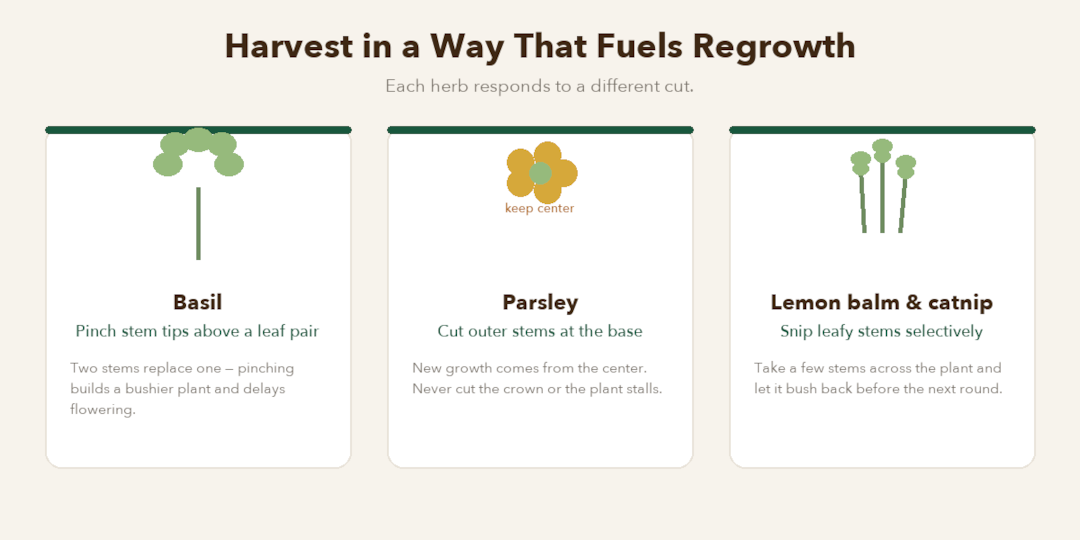
Basil: Pinch the Stem Tips
Genovese Basil, Lemon Basil, and Red Rubin Basil are grown primarily for their aromatic leaves — if you are choosing between them, our basil variety comparison breaks down the differences.
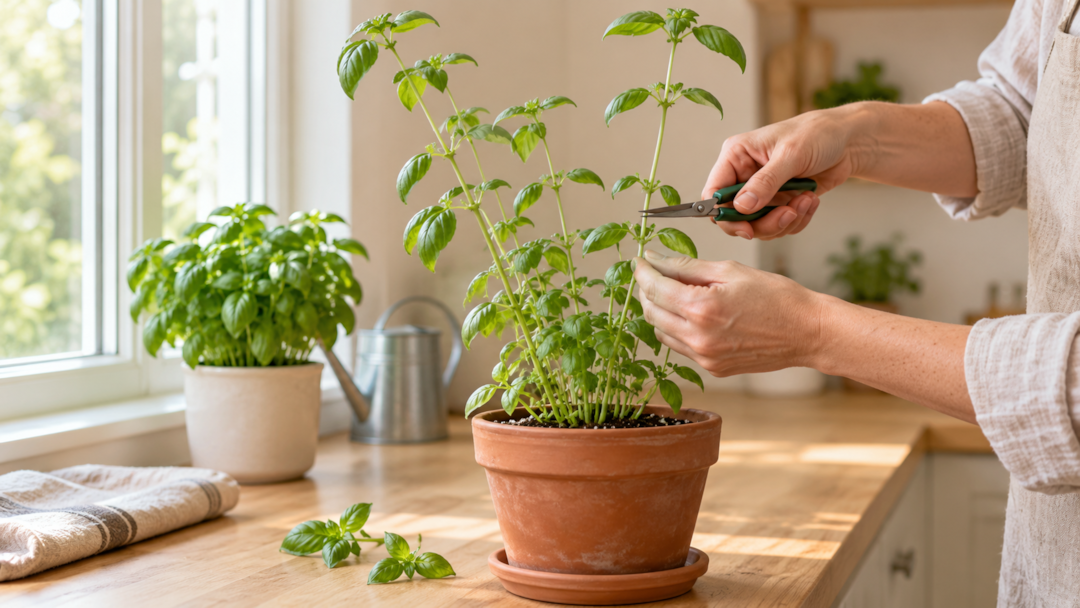
When the plant is sufficiently established, pinching or cutting the stem tips just above a suitable pair of leaves can encourage branching. This helps the plant develop a fuller shape and creates more opportunities for future leaf growth.
Avoid removing too much foliage from a small seedling. Allow the plant to establish enough leaves before beginning regular harvesting.
Also monitor flower buds as the plant matures. If your goal is continued leaf production, removing flower buds according to the variety's growing guidance can help maintain a leafy growth habit.
Parsley: Harvest Outer Leaves
Italian Flat Leaf Parsley and Dark Green Parsley typically take longer to establish than basil grown under favorable conditions. (Unsure which to pick? Flat leaf vs. dark green parsley compares them.)
Rather than cutting every leaf at once, harvest the older outer leaves from the base while protecting the central growing point.
This allows the plant to continue producing new leaves.
If your parsley looks small after several weeks, check whether it is still establishing rather than assuming it needs heavier harvesting or additional fertilizer.
Lemon Balm: Encourage Branching
Lemon balm can become bushier as it establishes — and once it does, lemon balm iced tea is the classic way to put those extra stems to work.
Once the plant has sufficient foliage, selectively pinch or cut leafy stems to encourage branching and keep the plant manageable.
Avoid removing too much foliage at once, particularly when the plant is young.
Catnip: Allow the Plant to Establish
Catnip is a perennial herb that develops foliage over time.
Once established, you can harvest selected leaves or leafy stems while leaving enough healthy growth for the plant to continue developing. Catnip tea from your indoor garden is one of the most rewarding uses for a plant that has finally filled out.
Its growth rate and mature size depend on the variety and growing conditions, so use the plant's actual development as your guide.
How to Tell Whether Your Indoor Herbs Are Healthy but Slow
Slow growth does not always indicate a problem. Look at the whole plant rather than focusing only on its size.
| What You Notice | Possible Explanation | What to Check |
|---|---|---|
| Seeds have not sprouted yet | Normal germination delay or unsuitable germination conditions | Seed age, moisture, temperature, and planting depth |
| Small but normally colored leaves | Young plant, natural growth rate, or insufficient light | Crop timeline, light intensity, and plant age |
| Long, thin stems | Insufficient light is a common cause | Light intensity, position, and daily schedule |
| Yellowing leaves | Nutrient imbalance, root stress, or watering problems | Root health, water conditions, and nutrient guidance |
| Wilting despite moist growing media | Root problems or other environmental stress | Root condition, drainage, and temperature |
| Healthy leaves but little new growth | Normal establishment period or limited growing conditions | Plant age, temperature, light, and root development |
| One plant grows much faster than another | Natural differences between crops or varieties | Species, cultivar, and environmental conditions |
These observations are starting points, not definitive diagnoses. Several growing problems can produce similar symptoms.
If multiple plants show the same symptoms at the same time, consider whether they share a common environmental issue, such as lighting, temperature, or nutrient conditions.
If only one plant is struggling, investigate its individual roots, foliage, and growing position.
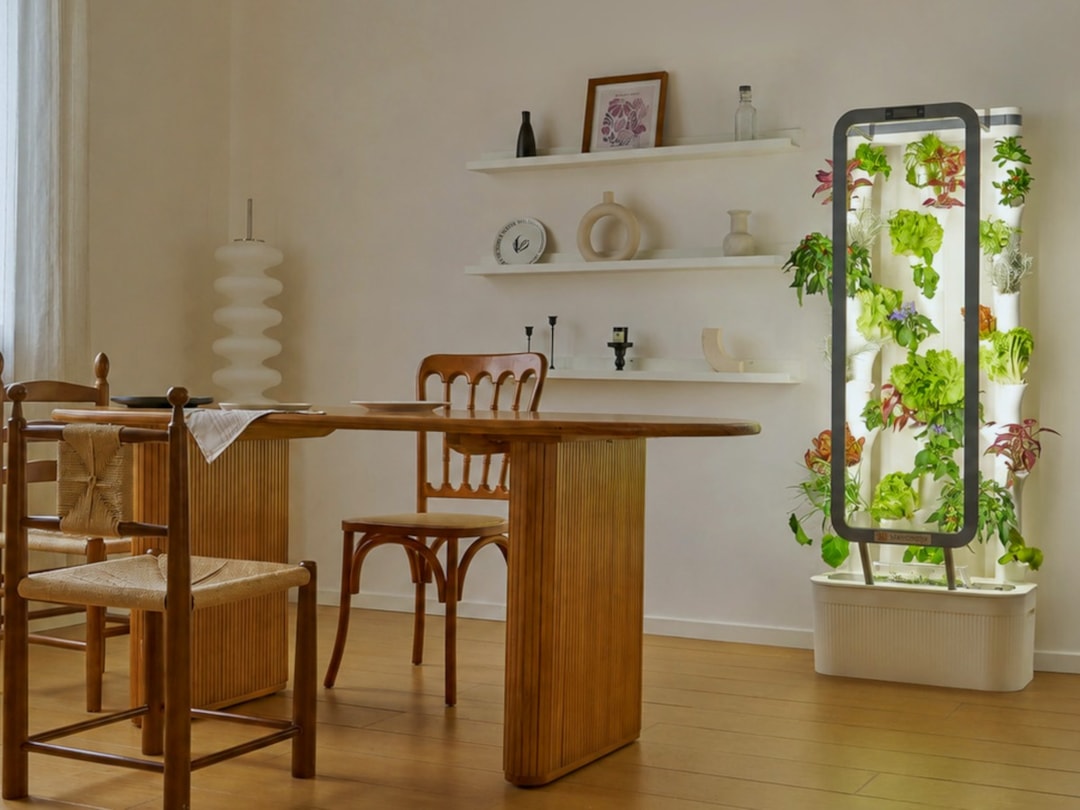
How Maygrove Verti 30 Can Help You Monitor Herb Growth
When growing several herb varieties in one indoor garden, it can be difficult to remember each plant's development timeline and identify when something is wrong.
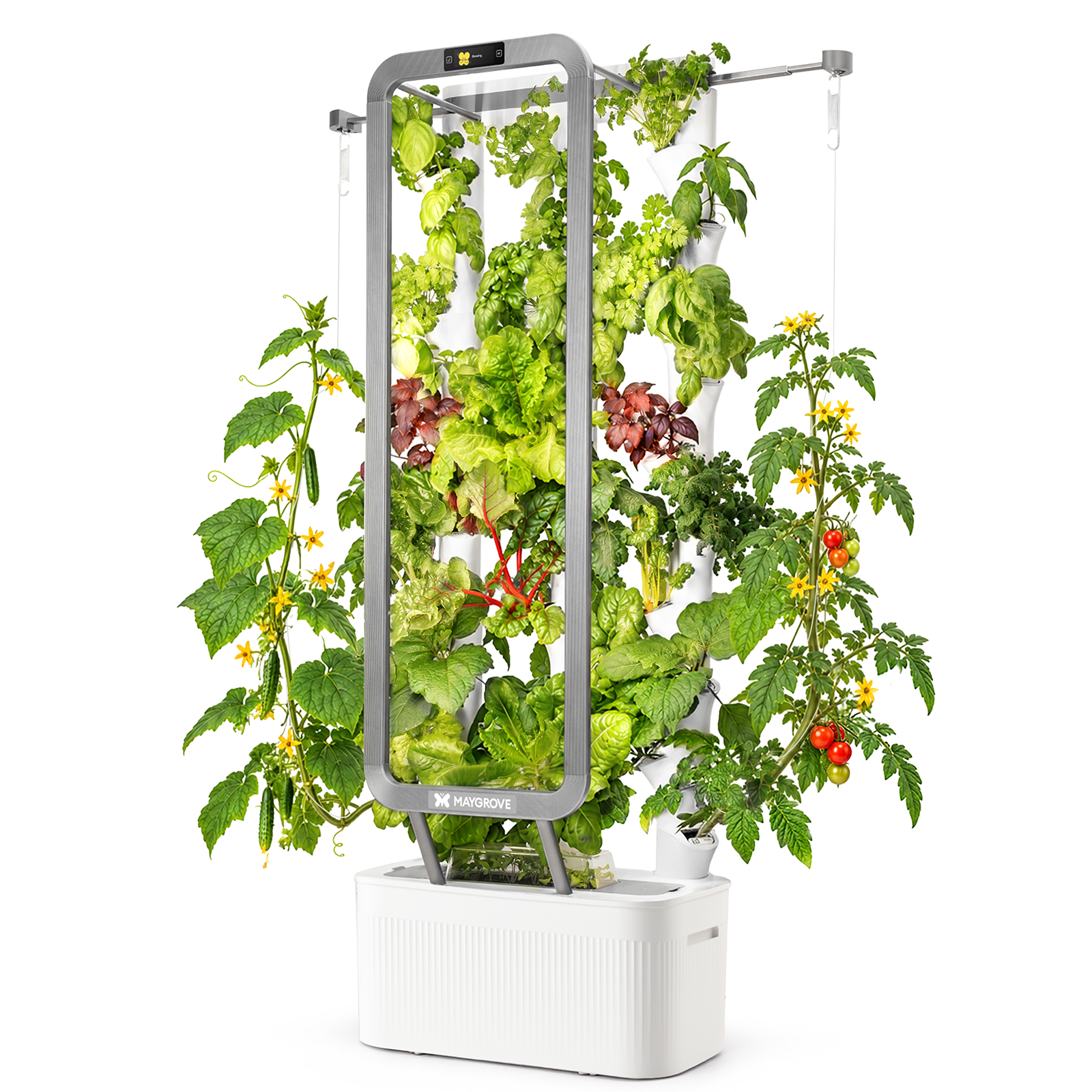
The Maygrove AI Growbot Verti 30 is designed to help users manage indoor growing with automated lighting and nutrient-management features. Mavi, Maygrove's AI gardening assistant, can help guide users from seed to harvest, including plant-space management, estimated germination timelines, harvest reminders, and monitoring or diagnosing potential plant problems.
This guidance can help you understand why one herb may be ready for harvesting while another is still establishing.
For example, basil and parsley should not necessarily be expected to produce harvestable leaves at the same time. Parsley may take longer to germinate, while basil can develop quickly under warm, bright conditions. Lemon balm and catnip may also follow different growth patterns as they establish.
Follow Mavi's recommendations alongside the system's current growing instructions. If a plant is developing slowly, consider its natural timeline before making adjustments to lighting, nutrients, or other growing conditions.
Automated growing features can help manage routine tasks, but they do not eliminate the need to observe individual plants and respond to their needs.
Frequently Asked Questions
Why is my basil growing so slowly indoors?
Basil may grow slowly because of insufficient light, cool temperatures, unsuitable root conditions, or nutrient problems. It grows best under appropriately warm conditions with adequate light. If your basil is healthy but small, check its age and growing conditions before increasing fertilizer or extending the lighting period.
Why does parsley take longer to grow than basil?
Parsley seeds often take longer to germinate than basil seeds. Parsley also needs time to establish its roots and produce enough leaves for harvesting. A slow start is not necessarily a sign that something is wrong.
How long does it take to harvest indoor herbs?
The timeline varies by crop and growing conditions. Basil may provide a light harvest within approximately 4–6 weeks after sowing under suitable conditions, while parsley often needs around 8–12 weeks or longer. These estimates vary by cultivar and environment, so use the plant's development and crop-specific guidance to determine when to harvest.
Do herbs grow slower indoors than outdoors?
They can, particularly when indoor lighting is weak or temperatures are unsuitable. However, indoor herbs can grow successfully when their light, temperature, root-zone, and nutrient requirements are met. A suitable indoor growing system can help provide more consistent conditions.
Should I add more fertilizer if my herbs are growing slowly?
Not automatically. Slow growth can result from insufficient light, cool temperatures, root problems, or the plant's natural development rate. Excess fertilizer can damage roots or create nutrient imbalances. Check the growing conditions and follow the recommended nutrient guidance before making changes.
Can I harvest basil while it is still small?
You can sometimes take a light harvest once basil is sufficiently established, but avoid removing too much foliage from a young plant. Let it develop enough leaves and stems to support continued growth before harvesting regularly.
Why are my indoor herbs growing at different speeds?
Different herbs have different germination times, growth habits, and harvest timelines. Even plants of the same species can develop differently because of cultivar, light exposure, temperature, and root conditions. Compare each plant with its own expected growth pattern rather than expecting all herbs to grow at the same rate.
Why is my parsley not sprouting after two weeks?
That is usually normal, not a failure. Parsley commonly takes two to four weeks or longer to germinate, and even then germination can be uneven. Keep the growing medium evenly moist and give it the full window before assuming the seeds have failed.
Do all indoor herbs need the same temperature?
No. Basil is the classic warm-season herb — it wants roughly 75°F to germinate and suffers in cold drafts — while parsley, chives, and cilantro are cool-season herbs that tolerate cooler conditions. Check where your garden sits relative to windows, doors, and vents, and group herbs with compatible temperature needs.