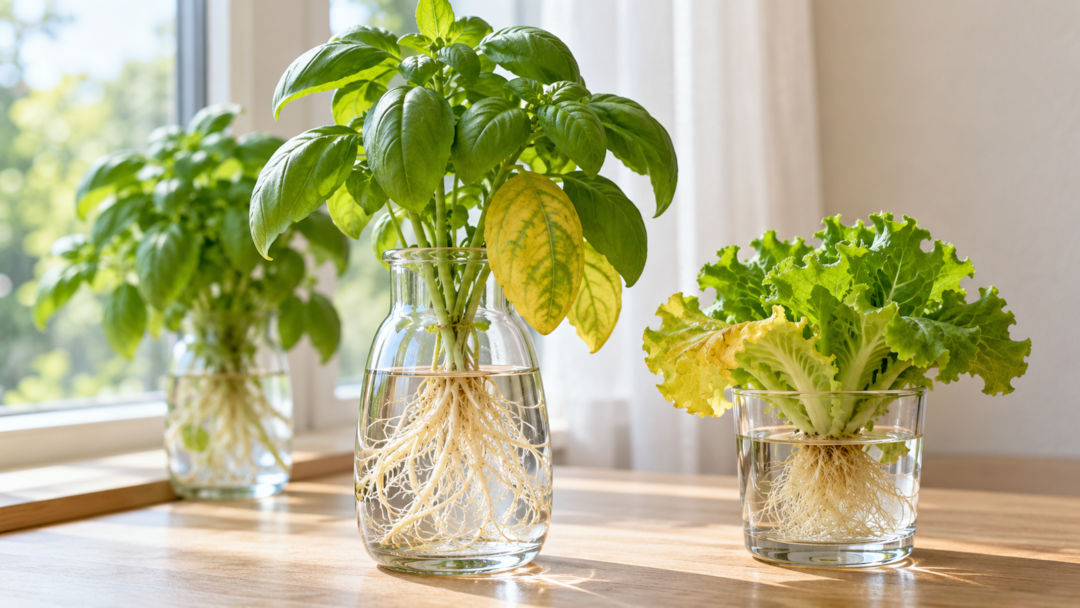
Yellow leaves are one of the most common problems in a hydroponic garden. You might notice older lettuce leaves turning pale, basil developing yellow patches, or a once-healthy plant losing its vibrant green color. Because hydroponic plants depend on a carefully balanced water-based growing environment, even a small change in nutrients, pH, or root conditions can affect leaf color.

However, yellow leaves do not automatically mean your plants need more fertilizer. Yellowing can result from nutrient deficiencies, pH imbalances, insufficient light, root stress, inconsistent water delivery, or natural aging. Adding more nutrients before identifying the cause can make the problem worse. If you are newer to these systems, how a hydroponic garden works explains where pH, EC, and dissolved oxygen fit into the picture.
The best approach is to start with the simplest checks, observe which leaves are affected, and make adjustments one at a time.
What Causes Yellow Leaves in a Hydroponic Garden?
The pattern and location of yellowing can offer useful clues. Before changing your nutrient solution, look at which leaves are turning yellow, how quickly the symptoms appeared, and whether the rest of the plant looks healthy.
| What You Notice | Possible Cause | What to Check First |
|---|---|---|
| Older, lower leaves turn uniformly yellow | Nitrogen deficiency, natural aging, or root stress | Nutrient balance, plant age, and root health |
| Young leaves turn yellow while veins remain green | Iron availability or pH-related nutrient uptake problems | Nutrient solution pH and root conditions |
| Yellowing appears between the veins of older leaves | Possible magnesium deficiency | Nutrient formulation and pH |
| Leaves develop yellow edges or patches | Nutrient imbalance, root stress, or environmental damage | Nutrient concentration, root health, and light exposure |
| Many leaves turn pale at once | Major environmental change, nutrient problem, or root-zone issue | Recent changes to lighting, nutrients, water delivery, and temperature |
| A few old leaves yellow while new growth looks healthy | Normal leaf aging | Whether the plant continues producing healthy new leaves |
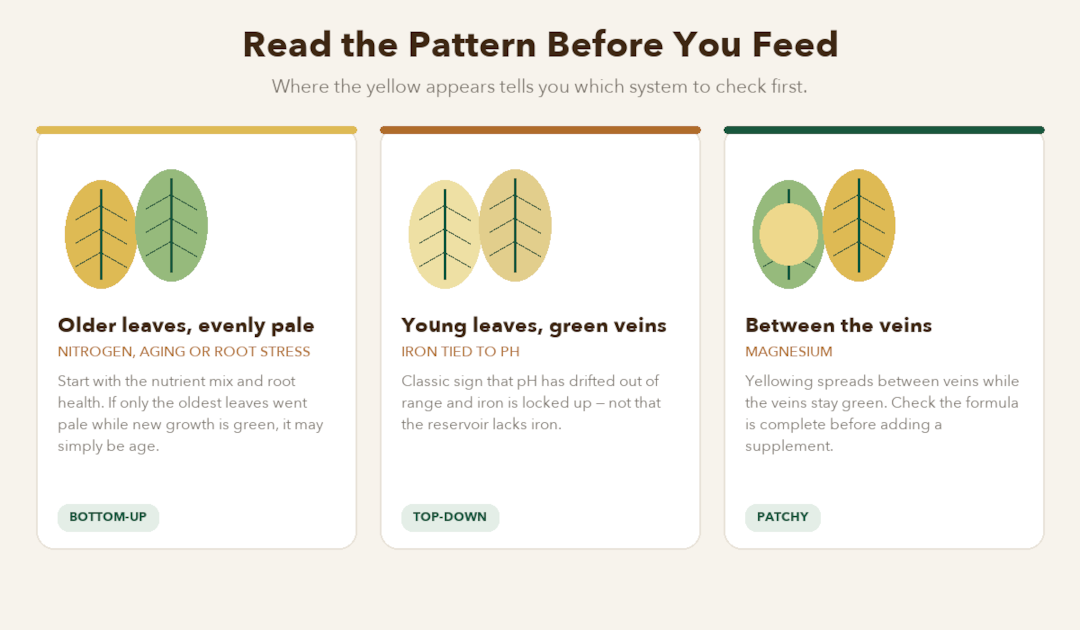
These patterns are clues, not definitive diagnoses. Several different problems can produce similar symptoms, so check the growing environment before treating a suspected deficiency.
1. Check Your Nutrient Solution First
Hydroponic plants obtain essential mineral nutrients from the water-based solution surrounding their roots. If the solution does not contain the nutrients a plant needs in suitable proportions, its leaves may lose their green color and growth may slow.
But there is an important distinction: a plant can show symptoms of nutrient deficiency even when the nutrient is present in the reservoir. If the pH is unsuitable or the roots are unhealthy, the plant may struggle to absorb it.
Could Your Plants Be Low in Nitrogen?
Nitrogen is essential for chlorophyll production and healthy leafy growth. When a plant cannot obtain enough nitrogen, older leaves often become pale green and then yellow. Growth may also slow, and the plant may produce smaller leaves.
Nitrogen deficiency can be particularly noticeable in leafy greens and herbs because their harvestable foliage is the main crop.
What to do:
- Check whether your hydroponic nutrient formula is suitable for the plants you are growing.
- Confirm that you have prepared the nutrient solution according to the product instructions.
- Review whether the nutrient solution has been diluted, replaced, or replenished incorrectly.
- Check pH and root health before concluding that nitrogen is the problem.
Avoid adding extra fertilizer simply because leaves look yellow. Excess nutrients can create additional imbalances and may damage roots. It also helps to know what a complete diet looks like for foliage crops — what nutrients do leafy greens provide breaks down the role of each mineral.
Could Another Nutrient Be Involved?
Different nutrients produce different symptom patterns, although the signs often overlap.
| Nutrient | Possible Yellowing Pattern | Important Consideration |
|---|---|---|
| Nitrogen | Older leaves become pale or uniformly yellow | Can also occur with natural aging or root problems |
| Iron | Young leaves turn yellow, sometimes with greener veins | Iron availability is affected by pH and nutrient chemistry |
| Magnesium | Older leaves develop yellowing between veins | Other nutrient imbalances can produce similar patterns |
| Sulfur | Newer growth may become uniformly pale | Less common when using a complete, properly prepared nutrient formula |
Use these patterns to guide your investigation rather than as a reason to add individual supplements immediately. A complete hydroponic nutrient formula, correctly mixed and maintained, is generally a better starting point than trying to correct each symptom separately.
2. Check the pH of Your Hydroponic Water
If there is one measurement worth checking before adding more fertilizer, it is pH.
The pH of your nutrient solution influences how readily plants can absorb different nutrients. When pH moves outside the suitable range for a crop and growing system, some nutrients become less available to the roots.
This can create symptoms that resemble a nutrient deficiency even when the reservoir contains an adequate supply of minerals.
What Happens When pH Is Too High or Too Low?
A pH that is too high can reduce the availability of certain micronutrients, including iron. Young leaves may become yellow while their veins remain relatively green.
An unsuitable pH on the low side can also interfere with nutrient balance and may contribute to root stress.
Most hydroponic crops do well in a mildly acidic range between pH 5.5 and 6.5. UF/IFAS, for example, recommends pH 5.5–6.0 for hydroponic lettuce. The exact target shifts slightly by crop and system, so follow your setup's guidance rather than treating one number as universal.
How to Check and Correct pH
- Measure the nutrient solution with a suitable pH meter or test kit.
- Compare the result with the recommended range for your plants and system.
- If adjustment is necessary, use an appropriate pH-adjusting product according to its instructions.
- Make changes gradually, then recheck the solution.
- Monitor new growth over the following days rather than expecting yellow leaves to turn green immediately.
Avoid making large pH adjustments based on a single uncertain reading. If you use a digital meter, keep it maintained and calibrated according to the manufacturer's instructions.
Also remember that pH can change as plants absorb nutrients and water. A reading that was correct when you first mixed the reservoir may not remain stable indefinitely.
3. Inspect the Roots for Signs of Stress
Healthy roots are essential for absorbing water and nutrients. Even a well-balanced nutrient solution cannot support normal growth if the roots are damaged or unable to function properly.
Root problems can cause yellow leaves, slow growth, wilting, and general plant decline. Crowding is a quieter cause: if a vigorous plant has outgrown its site, our vertical garden spacing guide explains how to divide sites before roots stall.
What Healthy Hydroponic Roots Look Like
Healthy roots are generally firm and may appear white, cream-colored, or light tan, depending on the crop and growing conditions. Some discoloration can occur naturally, so color alone does not establish whether roots are healthy.
Look for additional warning signs, including:
- Roots that are slimy or unusually soft.
- An unpleasant or rotten smell around the root zone.
- Roots that are deteriorating or breaking apart.
- Plants that wilt despite having access to water.
- Rapid yellowing accompanied by declining growth.
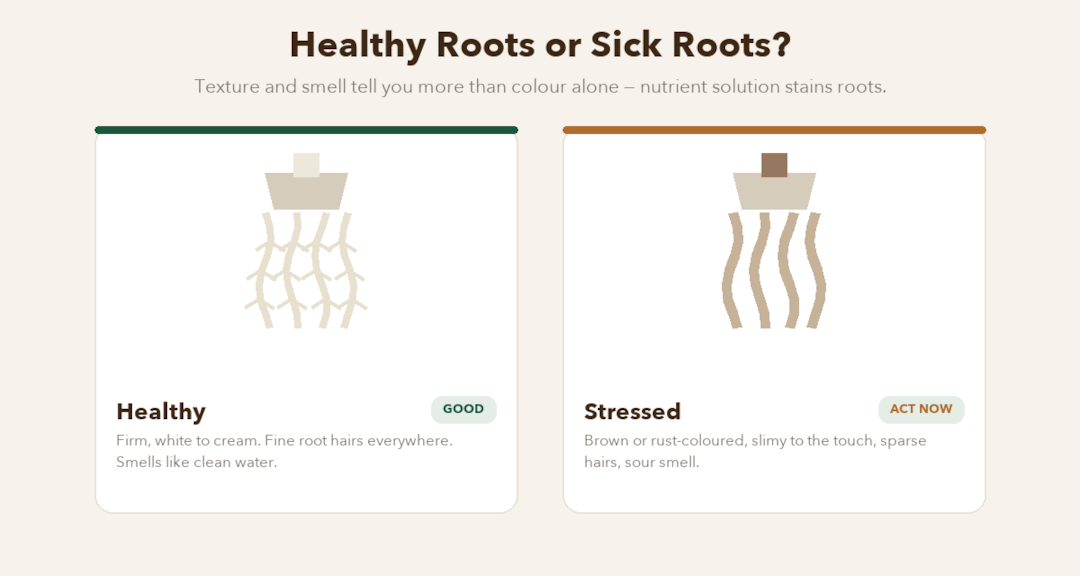
Nutrient solution can stain roots, and some root-zone materials naturally affect their appearance. Texture, smell, and overall plant condition are often more informative than color alone.
Check Water Delivery and Root-Zone Conditions
Depending on your hydroponic system, check that:
- Water or nutrient solution is reaching the roots as intended.
- Pumps, tubing, or other water-delivery components are working correctly.
- Roots are not becoming excessively crowded or obstructing water flow.
- The reservoir and root zone are maintained according to the system's instructions.
- Water temperature is appropriate for the plants and equipment.
In systems that use an aerated reservoir, confirm that aeration is functioning properly. In other systems, follow the manufacturer's guidance for how roots should contact the nutrient solution.
Colorado State Extension notes that most hydroponic root pathogens are opportunists that do the most damage to already-stressed plants — and the two conditions that tip a reservoir toward disease are low dissolved oxygen and warm root-zone temperatures (68–72°F is optimal). Water temperature deserves a check of its own: warm water holds less oxygen, so a reservoir sitting near a heater or in direct afternoon sun can stress roots even when the nutrient mix is perfect. If roots show signs of deterioration, adding more fertilizer will not solve the underlying problem — address root-zone conditions first.
4. Make Sure Your Grow Lights Are Providing Enough Light
Light affects photosynthesis, chlorophyll production, and the energy available for new growth. If plants receive too little usable light, they may become pale, grow slowly, or develop elongated stems and widely spaced leaves.
However, yellow leaves alone do not prove that your grow lights are too weak.
Signs That Light May Be the Problem
Look for a combination of symptoms:
- New growth is pale and noticeably stretched.
- Plants lean toward the light source.
- Leaves are smaller than expected.
- Growth is slow despite apparently suitable nutrient conditions.
- Plants in shaded positions show more symptoms than plants receiving better light.
If the symptoms are concentrated in one area of the garden, compare the plants' positions and light exposure before changing the entire system. Stretching and slow growth have their own diagnostic paths too — see why indoor herbs grow slowly and why basil gets tall and leggy for crop-specific versions of the same investigation.
Can Too Much Light Cause Yellow Leaves?
Yes. Excessive light intensity or heat can also stress plants. Depending on the crop and conditions, leaves may develop pale patches, bleaching, curling, or scorched areas.
Check whether the affected leaves are closest to the light source and whether the growing area is becoming too warm.
Instead of simply increasing the number of hours the lights are on, check both light intensity and daily light exposure. Longer lighting periods do not necessarily compensate for inadequate intensity, and plants generally benefit from an appropriate daily dark period.
Follow the lighting recommendations for your crop and equipment. If you make adjustments, do so gradually and observe the response.
5. Review Water Levels and Nutrient Concentration
Hydroponic plants need a consistent supply of water and nutrients, but more is not always better.
If the reservoir becomes too concentrated, excess dissolved salts can make it harder for roots to take up water and can interfere with nutrient balance. If the solution becomes too dilute, plants may not receive enough of the nutrients they need.
Both situations can contribute to poor growth and leaf discoloration.
Check EC or TDS if Your System Supports It
Electrical conductivity (EC) estimates the concentration of dissolved ions in a solution. Total dissolved solids (TDS) meters estimate dissolved solids, often using a conversion from EC.
These readings help you assess nutrient concentration, but they do not identify which individual nutrients are present or whether their proportions are correct.
A suitable EC target depends on the crop, plant growth stage, water source, and nutrient formula. For scale: UF/IFAS recommends about 1.2–1.5 mS/cm (~800 ppm) for mature hydroponic lettuce, while Cornell's seedling research suggests starting seedlings at roughly half that strength. Herbs and fruiting crops sit at different points on the scale — match the number to your crop and stage rather than borrowing one.
If your system provides EC monitoring:
- Check the current reading.
- Compare it with the recommended range for your crop and nutrient formula.
- Consider whether the reservoir has lost water through evaporation and plant uptake.
- Follow your system's instructions for topping up, replenishing, or replacing the solution.
Do not assume that a higher EC means healthier plants. An overly concentrated solution can cause stress, while a seemingly normal reading does not rule out an imbalance in individual nutrients.
If you do not have an EC meter, check that your nutrient solution is mixed correctly and maintained according to the product and system instructions.
6. Consider Temperature and Environmental Stress
Temperature affects root function, water uptake, and the rate at which plants use nutrients. Conditions that are too hot or too cold can interfere with normal growth even when the nutrient solution is correctly prepared.
For example, high temperatures may increase water demand and stress roots. Cold conditions can slow growth and nutrient uptake in temperature-sensitive crops.
Look for patterns that connect yellowing with environmental changes:
- Did the growing area become unusually hot or cold?
- Is the nutrient reservoir exposed to a heat source?
- Are plants positioned near a draft or heating vent?
- Did yellowing begin after you changed the lighting schedule or moved the garden?
- Are all plants affected, or only one crop?
Different crops have different temperature preferences. Leafy greens and warm-season fruiting plants should not automatically be managed using the same environmental targets. Romaine lettuce, for instance, wants 60–75°F — our romaine growing guide covers its full comfort zone — while basil and peppers are happier several degrees warmer.
Correct the condition that is outside the recommended range for your crop, then give the plant time to respond.
7. Rule Out Normal Leaf Aging
Not every yellow leaf signals a problem.
As plants grow, older leaves eventually age and may yellow before falling off. This is particularly common when the plant continues to produce healthy new growth.
Natural aging is more likely when:
- Only a small number of the oldest leaves are affected.
- The yellowing develops gradually.
- New leaves remain green and healthy.
- The plant continues growing at its expected rate.
- There are no signs of root damage or widespread environmental stress.
For example, an older outer leaf on a mature lettuce plant may yellow while younger leaves remain healthy. A few aging lower leaves on an established herb can also be normal.
However, widespread yellowing, rapid progression, or yellowing that reaches new growth deserves closer investigation.
Removing a few fully yellow or deteriorating leaves can improve airflow and make it easier to monitor the plant, but pruning does not correct the underlying cause if a growing problem is present.
A Simple Troubleshooting Checklist for Yellow Leaves
If you are unsure where to begin, follow this order rather than changing several variables at once.
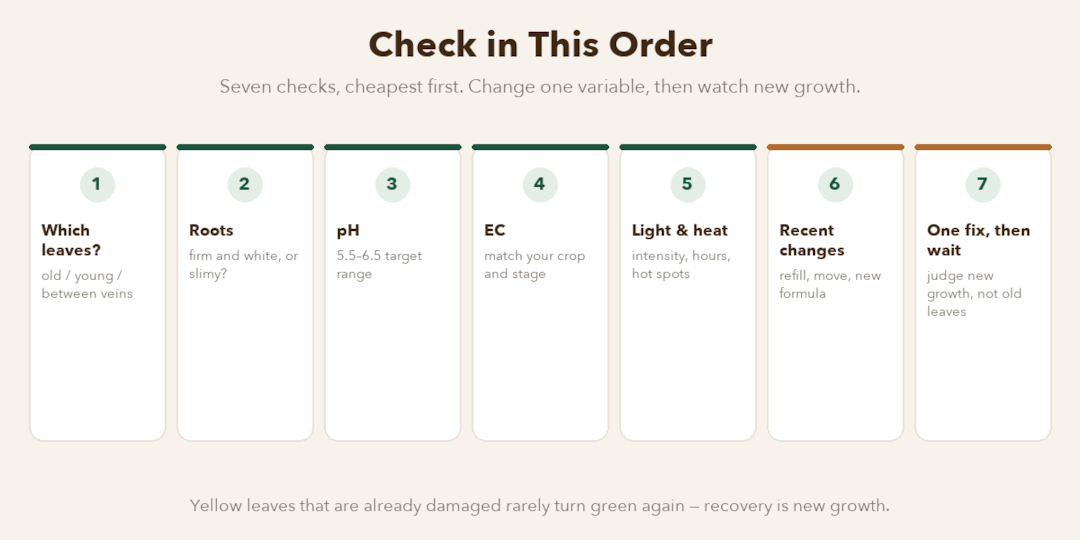
Step 1: Identify Which Leaves Are Yellow
Ask yourself:
- Are the oldest leaves affected first?
- Are the youngest leaves turning yellow?
- Is the yellowing uniform, between the veins, or concentrated around the edges?
- Are there spots, browning, curling, or wilting as well?
This helps narrow the list of possible causes.
Step 2: Inspect the Roots
Check for unusual softness, slime, unpleasant odors, or signs that water delivery is not working properly.
If the roots appear unhealthy, address root-zone conditions before adding more nutrients.
Step 3: Measure pH
Check the nutrient solution and compare the reading with the recommended range for your crop and system in the 5.5–6.5 range.
Correct an unsuitable pH carefully before assuming the plant needs additional fertilizer.
Step 4: Check Nutrient Concentration
If available, measure EC and compare it with the target for your nutrient formula and crop. Also verify that the solution was mixed correctly.
Step 5: Review Lighting and Temperature
Check light intensity, lighting duration, heat exposure, and the temperature around the plants and roots.
Step 6: Look for Recent Changes
Think about what changed shortly before the symptoms appeared. You may have refilled the reservoir, changed the nutrient formula, adjusted the lights, or moved a plant.
A recent change does not automatically explain the problem, but it provides a useful starting point.
Step 7: Make One Adjustment and Monitor
Correct the most likely underlying issue, then observe the plant over the next several days.
Existing yellow leaves may not turn green again, even after the problem is corrected. Healthy new growth is often a better sign of recovery than the color of leaves that were already damaged.
Avoid repeatedly changing pH, nutrient concentration, and lighting at the same time. Doing so makes it harder to identify the cause and may introduce additional stress.
How to Prevent Yellow Leaves in a Hydroponic Garden
Prevention is easier when you maintain a consistent growing environment and notice small changes before they become widespread. If you are building your routine from scratch, indoor gardening for beginners covers the fundamentals.
Maintain a Consistent Nutrient Routine
Use a complete nutrient formula appropriate for your crops. Mix it according to the instructions, and follow your system's guidance for replenishment and solution replacement.
Avoid adding extra nutrients without a clear reason.
Monitor pH Regularly
Check pH at the frequency recommended for your system. If your setup does not monitor pH automatically, periodic manual checks can help you detect changes before they affect plant growth.
Keep Water Delivery Reliable
Inspect pumps, tubing, reservoirs, and other components as appropriate for your system. Make sure the roots receive water and nutrients in the way the system was designed to deliver them.
Match Light to the Crop
Different plants have different light requirements. Leafy greens, herbs, peppers, and other fruiting crops may need different levels of light intensity and daily exposure.
Follow crop-specific recommendations rather than using one lighting schedule for every plant.
Observe Plants as They Grow
Make a habit of checking the oldest leaves, new growth, roots, and overall plant shape. A quick daily visual check can help you spot developing symptoms early.
For a mixed indoor garden, keeping track of which crops occupy each growing position can also help you recognize whether a problem affects one plant variety or the entire system.

How Maygrove Can Help You Monitor Your Indoor Garden
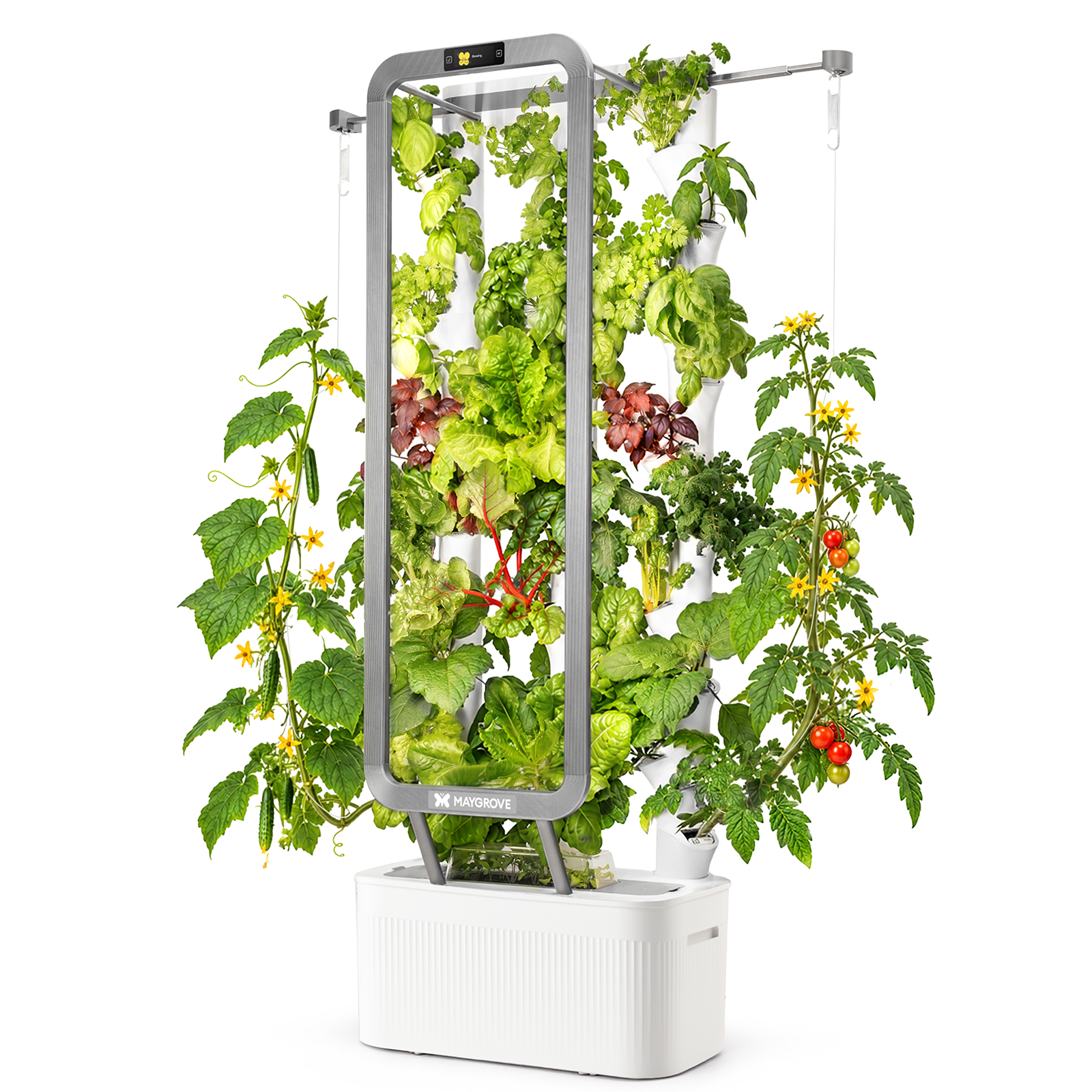
The Maygrove AI Growbot Verti 30 is built to keep the variables above in their happy ranges automatically. Its EC/TDS sensor monitors nutrient concentration and adjusts Plant Food dosing to match your recipe. Alternating pumps keep water — and oxygen — moving, while peristaltic pumps dispense Plant Food and System Balance precisely. Water-level sensors trigger automatic refills, so dosing stays accurate even as plants drink more mid-cycle.
Instead of troubleshooting drift after it shows up in the leaves, you start each day with a system that corrected it overnight — and a quick glance at the app confirms pH, nutrients, and water levels are where they should be.
Frequently Asked Questions
Should I remove yellow leaves from hydroponic plants?
You can remove fully yellow, dead, or deteriorating leaves, especially if they are no longer contributing much to the plant. However, removing leaves will not solve the underlying problem if yellowing is caused by nutrient imbalance, unsuitable pH, root damage, or environmental stress.
If only one or two older leaves are yellow and the rest of the plant looks healthy, you may not need to do anything immediately.
Can I fix yellow leaves by adding more nutrients?
Not necessarily. Yellow leaves can result from a nutrient deficiency, but they can also indicate unsuitable pH, root stress, excessive nutrient concentration, or normal aging.
Check pH, nutrient concentration, and root health before increasing fertilizer. Adding more nutrients without identifying the cause can make the problem worse.
Why are my hydroponic plants turning yellow even though I add nutrients?
The nutrient solution may be incorrectly mixed, too concentrated, or missing nutrients needed by the crop. Alternatively, an unsuitable pH or unhealthy roots may prevent the plant from absorbing nutrients effectively.
Confirm that the nutrient formula is appropriate, check pH and EC if possible, and inspect the roots.
Why are only the lower leaves turning yellow?
Older lower leaves may be aging naturally, especially when new growth looks healthy. However, yellowing that begins on older leaves can also be associated with nitrogen deficiency or root stress.
Look at how quickly the symptoms develop and whether the yellowing spreads to other parts of the plant.
Why are the new leaves on my hydroponic plants yellow?
Yellowing in young leaves can be associated with reduced availability of nutrients such as iron, often because of pH-related uptake problems. Other nutrient imbalances and root-zone conditions can produce similar symptoms.
Check pH first, then assess the nutrient formula and root health before adding a supplement.
How long does it take for a hydroponic plant to recover from yellow leaves?
Recovery depends on the cause and how severely the plant has been affected. After you correct the underlying problem, you may begin to see healthier new growth over the following several days, although some plants take longer.
Previously yellowed leaves may remain yellow. Monitor new leaves, growth rate, and overall plant condition to determine whether the plant is recovering.
Is it normal for hydroponic lettuce to have yellow leaves?
Occasional yellowing of older outer leaves can be normal as lettuce grows. Widespread yellowing, pale new growth, stunted growth, or yellowing accompanied by root problems is more concerning.
Check the plant's age, nutrient conditions, pH, lighting, and root health before deciding whether the yellowing is natural.