Your pepper plant looks healthy, new leaves are growing, and flowers are finally appearing. But instead of developing peppers, the flowers fall off, dry up, or disappear without leaving behind a tiny fruit.
If you're growing Cal Wonder Bell Pepper, Golden Cal Wonder Bell Pepper, Mini Yellow Bell Pepper, Mini Red Bell Pepper, or Long Slim Cayenne Pepper indoors, this can be especially frustrating. You've waited for the plant to mature, and flowering seems like a sign that harvest time is getting closer. Yet nothing happens.
The good news is that flowering without fruiting does not necessarily mean your pepper plant is unhealthy. Flower production and fruit development are separate stages. A pepper plant can produce flowers but fail to set fruit when environmental conditions are unsuitable, pollination is unsuccessful, or the plant is under stress.
Temperature, light, water, nutrients, and pollination all influence whether flowers develop into peppers. Indoor growing introduces additional considerations because plants may have less natural airflow and fewer opportunities for insects to move pollen.
In this guide, you'll learn why pepper plants flower without producing fruit, how to identify the likely cause, and what to do to improve fruit set in your indoor garden.
How Do Pepper Flowers Turn Into Peppers?
Before troubleshooting, it helps to understand what should happen after a pepper plant flowers.
Pepper plants produce flowers that contain the reproductive structures needed for fruit development. After successful pollination and fertilization, the flower's ovary can develop into a pepper.
The process generally follows these stages:
- Flower formation: The plant develops flower buds.
- Flower opening: The flower opens and its reproductive structures become accessible.
- Pollination: Pollen reaches the stigma, the receptive part of the flower.
- Fertilization: Successful fertilization triggers development of the fruit and seeds, although some peppers can also develop fruit with few or no seeds.
- Fruit development: The flower fades, and the young pepper begins to enlarge.
If a flower is not successfully pollinated or the plant cannot support fruit development, it may wither and fall without producing a visible pepper.
However, not every flower that falls indicates a pollination problem. Environmental stress can interfere with flower retention and fruit development even when pollen transfer occurs.
The key is to determine whether your plant is failing to pollinate, dropping flowers because of stress, or simply not yet at the fruit-development stage.
7 Reasons Your Pepper Plants Are Flowering but Not Fruiting
1. The Temperature Is Too Hot or Too Cold
Temperature is one of the most important factors affecting pepper flowering and fruit set.
Peppers are warm-season plants, but they do not thrive under every warm condition. Temperatures that are too high or too low can interfere with pollen function, fertilization, flower retention, and fruit development.
Excessive heat can be particularly problematic. During hot periods, pepper flowers may drop before fruit develops. Cool conditions can also slow plant development and interfere with successful fruit set.
Indoor growers sometimes overlook temperature because the room feels comfortable to people. However, temperatures around a sunny window, near a grow light, or close to heating and cooling equipment may differ from the general room temperature.
What to do:
- Check the temperature near the plant canopy rather than relying only on the room thermostat.
- Avoid exposing pepper plants to sudden temperature changes.
- Keep plants away from cold drafts and direct blasts of air from heating or cooling equipment.
- Follow the recommended temperature range for your specific pepper variety and growing system.
- Observe whether flower drop coincides with unusually hot or cool conditions.
If flowers consistently drop during temperature extremes, improve the growing environment before making major changes to nutrients or pollination practices.
2. Your Pepper Flowers Are Not Being Pollinated Successfully
Unlike many indoor leafy greens, peppers need successful pollination and fertilization to produce fruit.
The good news is that pepper flowers are generally self-pollinating. A single plant can produce fruit without another pepper plant nearby because its flowers contain both male and female reproductive structures.
However, self-pollinating does not mean that pollen transfer always happens successfully.
Outdoors, natural air movement and the activity of insects can help move pollen within flowers. Indoors, airflow may be limited, especially in sheltered growing systems.
If the flowers open but repeatedly fail to develop into small peppers, pollination is worth investigating.
What to do:
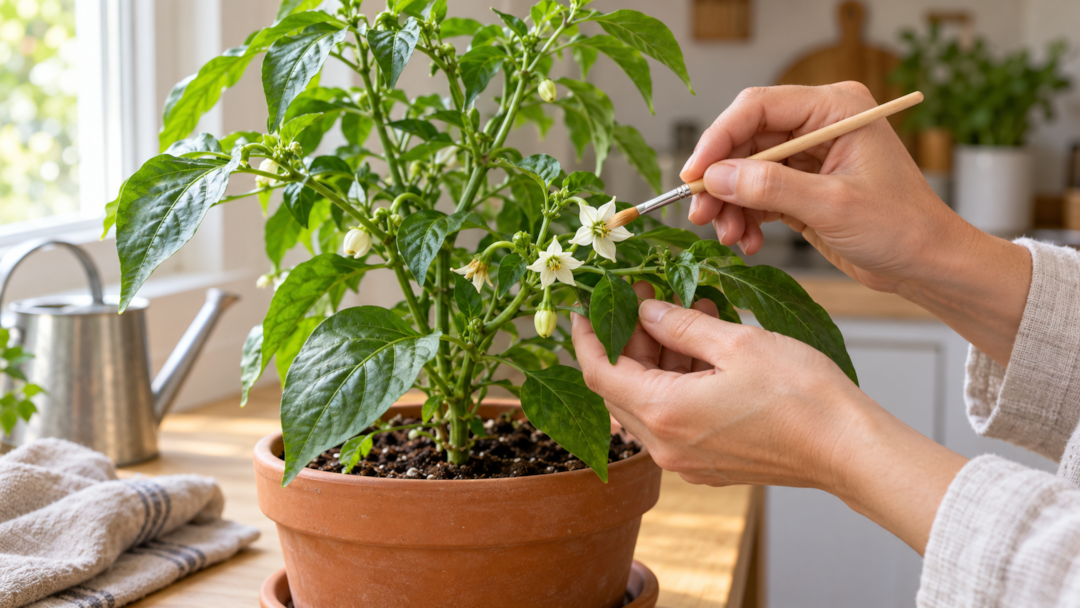
- Gently tap a flowering stem to help release and distribute pollen.
- Alternatively, use a small, soft brush to lightly transfer pollen within an open flower.
- Avoid damaging the delicate flower or its reproductive structures.
- Repeat gently on newly opened flowers when appropriate.
- Make sure temperature and plant health are also suitable for fruit set.
You do not necessarily need to hand-pollinate every pepper flower. Many indoor pepper plants can pollinate themselves successfully, but gentle assistance may help when airflow is limited.
Remember that pollination is only one possible cause of flower drop. If the plant is under heat stress or receiving insufficient light, hand-pollination alone may not solve the problem.
3. Your Pepper Plant Is Not Receiving Enough Light
Pepper plants generally need substantial light to support vigorous growth, flowering, and fruit development.
A plant may produce flowers under marginal lighting but struggle to sustain them or develop fruit. This is especially relevant indoors, where light intensity can be much lower than it appears.
A bright room is not necessarily bright enough for a fruiting vegetable.
Common signs that light may be insufficient include:
- Long, thin stems.
- Sparse foliage.
- Slow overall growth.
- A plant leaning toward the light source.
- Limited flowering or poor fruit development.
Insufficient light is not the only possible explanation for these symptoms, but it should be checked early.
What to do:
- Confirm that your grow light is appropriate for fruiting vegetables.
- Check the manufacturer's recommendations for light intensity, distance, and daily duration.
- Make sure the entire canopy receives adequate light.
- Avoid allowing larger neighboring plants to shade the pepper.
- Maintain a consistent daily lighting schedule with a regular dark period.
Many indoor pepper plants benefit from approximately 14–16 hours of suitable grow light per day, depending on light intensity, cultivar, and growing conditions. This is a general starting range, not a guarantee of successful fruiting.
Increasing the lighting duration will not necessarily help if the light itself is too weak. Both intensity and duration matter.
4. The Plant Has Too Little Energy to Support Fruit Development
Flowering and fruiting require resources. A pepper plant needs healthy leaves to capture light and produce the carbohydrates that support growth.
If the plant is small, weak, or still establishing, it may produce flowers before it has enough capacity to support substantial fruit development.
This can happen when plants receive insufficient light, have damaged roots, or experience inconsistent water and nutrient conditions.
A plant may also drop some flowers naturally as part of regulating its reproductive load.
What to do:
- Check whether the plant has developed a healthy canopy.
- Look for consistent new leaf growth.
- Confirm that the roots are healthy and the plant is not experiencing water stress.
- Follow the recommended nutrient program for the crop.
- Avoid encouraging heavy fruit production before the plant is sufficiently established.
A few dropped flowers do not automatically mean something is wrong. Look for a repeated pattern, such as many flowers falling without fruit developing over an extended period.
If the plant is still small, maintaining healthy vegetative growth may be more useful than trying to force immediate fruit production.
5. Watering Is Inconsistent
Pepper plants need a stable supply of water to support leaf growth, flowering, and fruit development.
Both water shortage and excessive root-zone moisture can interfere with plant health. When roots cannot take up water effectively, the plant may struggle to maintain flowers and young fruit.
Inconsistent moisture can be particularly challenging in small containers or compact indoor growing systems, where root-zone conditions may change relatively quickly.
Hydroponic systems have different watering requirements from soil-based containers, but they still depend on healthy roots and appropriate water conditions.
What to do:
- Check whether the root zone is receiving water consistently.
- Avoid allowing container-grown peppers to dry out severely between waterings.
- Ensure that soil-based containers drain appropriately.
- In hydroponic systems, follow the manufacturer's guidance for water levels, circulation, and root health.
- Look for wilting, damaged roots, or other signs of water-related stress.
Do not respond to flower drop by automatically adding more water. A plant with overwatered or damaged roots may wilt even when the growing medium is wet.
Identify the actual problem before changing your watering routine.
6. Nutrient Levels Are Unbalanced
Pepper plants need an appropriate balance of nutrients throughout their growth cycle.
If nutrient availability is insufficient, the plant may struggle to develop healthy leaves and flowers. However, excessive nutrient concentrations or an unsuitable nutrient balance can also interfere with growth and fruit production.
One common mistake is applying too much nitrogen in the hope of making the plant grow faster.
Nitrogen is essential for leaf and stem development, but excessive nitrogen relative to the plant's overall needs can encourage vegetative growth at the expense of balanced reproductive development.
This does not mean that nitrogen should be withheld. Pepper plants need adequate nutrition for both growth and fruiting.
What to do:
- Follow the nutrient recommendations for your growing system and crop.
- Avoid adding extra fertilizer simply because flowers are falling.
- Check pH and nutrient concentration if your system provides those measurements.
- Monitor root health and water conditions, since they affect nutrient uptake.
- Use a nutrient program designed for peppers rather than assuming every vegetable has identical requirements.
Yellow leaves, slow growth, and flower drop can have several causes. Do not diagnose a nutrient deficiency from a single symptom alone.
If the plant has healthy foliage but is not setting fruit, first check temperature, light, and pollination before changing the nutrient balance.
7. The Plant Is Not Mature Enough or Has Not Reached Its Fruiting Stage
Flowering is an important milestone, but it does not guarantee immediate harvest.
Pepper plants need time to establish themselves and develop the resources required to support fruit. The time from sowing to the first harvest varies according to the variety, growing conditions, and whether you're measuring from seed sowing, transplanting, or flowering.
Small-fruited peppers may produce harvestable fruit sooner than some larger bell pepper varieties, but this is not a universal rule.
If your plant has only recently started flowering, it may simply need more time.
What to do:
- Check the expected maturity timeline for your specific variety.
- Distinguish between days to maturity from sowing and days to maturity after transplanting.
- Observe whether the plant is producing new flowers and healthy foliage.
- Allow time for successful flowers to develop into visible young fruit.
- Avoid changing several growing conditions simply because the first flowers have not produced peppers yet.
If the plant repeatedly flowers and drops nearly every flower over time, investigate environmental conditions and pollination rather than assuming it only needs patience.
How to Troubleshoot Pepper Flower Drop
If your pepper plants are flowering but not producing fruit, use this checklist to narrow down the likely cause.
| What You Observe | Possible Cause | What to Check First |
|---|---|---|
| Flowers fall during very hot conditions | Heat stress | Temperature near the plant canopy |
| Flowers open but no tiny peppers develop | Pollination may be unsuccessful | Gentle movement of flowering stems and indoor airflow |
| The plant is tall and sparse | Insufficient light | Light intensity, distance, and coverage |
| The plant wilts or grows unevenly | Water or root-zone stress | Moisture, root health, and system instructions |
| The plant has very lush foliage but poor fruit set | Several causes are possible, including excess nitrogen or unsuitable light and temperature | Overall growing conditions and nutrient guidance |
| The plant has only recently started flowering | Normal developmental timing | Variety-specific maturity and fruit-development timeline |
| Almost every flower drops repeatedly | Persistent environmental or plant-health issue | Temperature, light, pollination, water, and nutrients |
These symptoms can overlap. For example, a plant with insufficient light may also develop weak growth, while temperature stress can affect both pollination and flower retention.
Start with the most likely environmental factors—temperature and light—then assess pollination, water, roots, and nutrients.
Avoid making several major adjustments at once. If you change the lighting schedule, nutrient concentration, and watering routine simultaneously, it becomes difficult to determine which change helped.
Frequently Asked Questions
Why does my pepper plant flower and then drop the flowers?
Pepper flowers may drop because of excessive heat, cool conditions, insufficient light, water stress, unsuccessful pollination, or other plant-health issues. A few dropped flowers can be normal, but repeated flower drop without fruit development suggests that the growing conditions need closer attention.
Do pepper plants need to be pollinated by hand indoors?
Not always. Pepper flowers are generally self-pollinating, meaning a single plant can produce fruit without another pepper plant nearby. However, gentle movement of the flowering stems or careful use of a soft brush may help when indoor airflow is limited.
How long after flowering should peppers start growing?
After successful pollination and fertilization, a small pepper may become visible within several days, although the timing varies by variety and growing conditions. The fruit then needs additional time to reach harvest size and, for colored varieties, develop its mature color.
Can a pepper plant produce flowers but never produce peppers?
Yes. Persistent unsuitable temperatures, insufficient light, poor pollination, root stress, or nutrient problems can prevent flowers from developing into fruit. If the plant repeatedly flowers without setting fruit, assess the growing environment rather than focusing on flowers alone.
Does a pepper plant need more fertilizer to produce fruit?
Not necessarily. Excess fertilizer can create nutrient imbalances, and too much nitrogen may encourage vegetative growth without improving fruit production. Follow the recommended nutrient program and investigate light, temperature, and pollination before increasing fertilizer.
Can indoor bell peppers produce fruit without bees?
Yes. Bell peppers are generally self-pollinating and do not require bees to produce fruit. However, successful pollen transfer and fertilization still depend on suitable flower conditions. Gentle vibration or movement can sometimes help in indoor environments.
Why are my mini bell peppers flowering but not fruiting?
Mini bell peppers can experience the same fruit-set problems as larger bell peppers. Check temperature, light intensity, pollination, water, and nutrient conditions. Smaller fruit size does not remove the plant's need for a suitable growing environment.
The Bottom Line
If your pepper plants are flowering but not fruiting, don't assume that you need more fertilizer or another pepper plant.
Start by checking temperature, light, and pollination, then investigate water conditions, root health, and nutrient balance. Give newly flowering plants enough time to develop, and distinguish an occasional dropped flower from a persistent failure to set fruit.
Cal Wonder Bell Pepper, Golden Cal Wonder Bell Pepper, Mini Yellow Bell Pepper, Mini Red Bell Pepper, and Long Slim Cayenne Pepper can all produce fruit indoors when their growing requirements are met, but their exact needs and timelines vary by variety.
With suitable growing conditions, healthy plants, and careful observation, you can improve the chances that your pepper flowers develop into the harvest you've been waiting for.