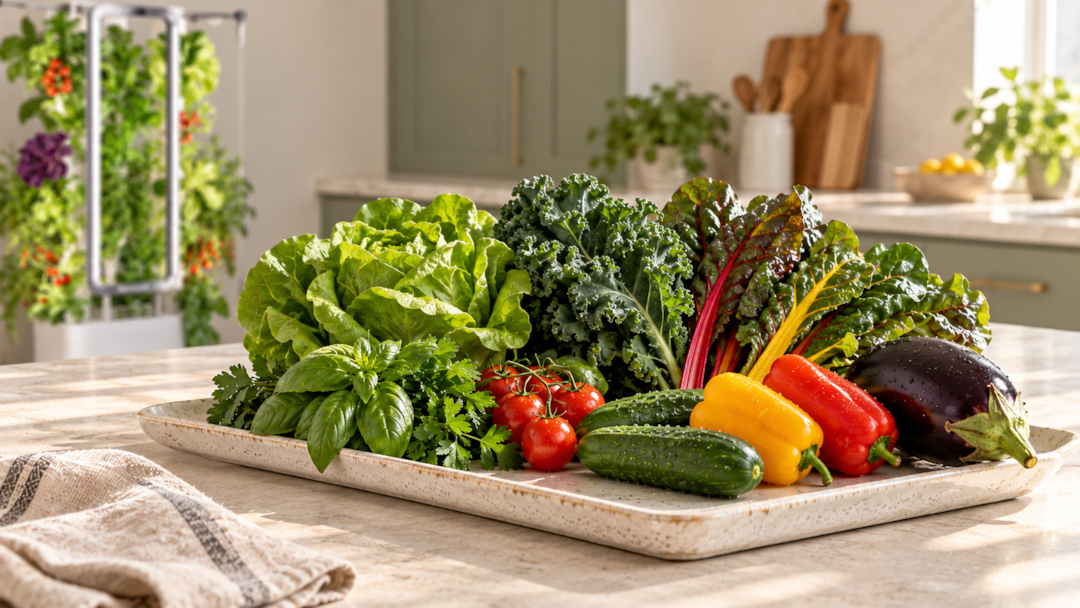
One of the biggest challenges in a vertical garden is deciding how many plants to grow in the available space. It is tempting to fill every planting site, especially when growing leafy greens and herbs. But planting more does not always mean harvesting more.
Here is the twist that surprises most beginners: in a tower garden, you barely control spacing at all. The distance between planting sites is fixed by the manufacturer before the box is ever opened. Your real spacing decisions are different ones—which sites to fill, which to leave empty, and which crops to place next to which.
This guide explains both sides: the plant science behind why crowding hurts, and the practical art of planning a layout on a system with fixed sites, using the Maygrove AI Growbot Verti 30—30 growing sites in 2.61 square feet—as a worked example.
Why Spacing Works Differently in a Vertical Garden
In a soil bed, spacing is a distance you choose: you dig holes 10 or 18 inches apart and the plant grows into whatever room you gave it. In a vertical hydroponic system, that freedom disappears. Plants sit in fixed cups, often just a few inches apart, sharing one reservoir and one light source.
Three things follow from that, and each one changes how you should think about spacing:
- Light comes from one direction. A grow light sits above or around the tower. A plant's leaves shade whatever is below them far more decisively than the sun would, because there is no sky light wrapping around the canopy.
- Root zones are shared. Every plant draws from the same water and nutrients, so competition below the surface is less about territory and more about total demand on the system.
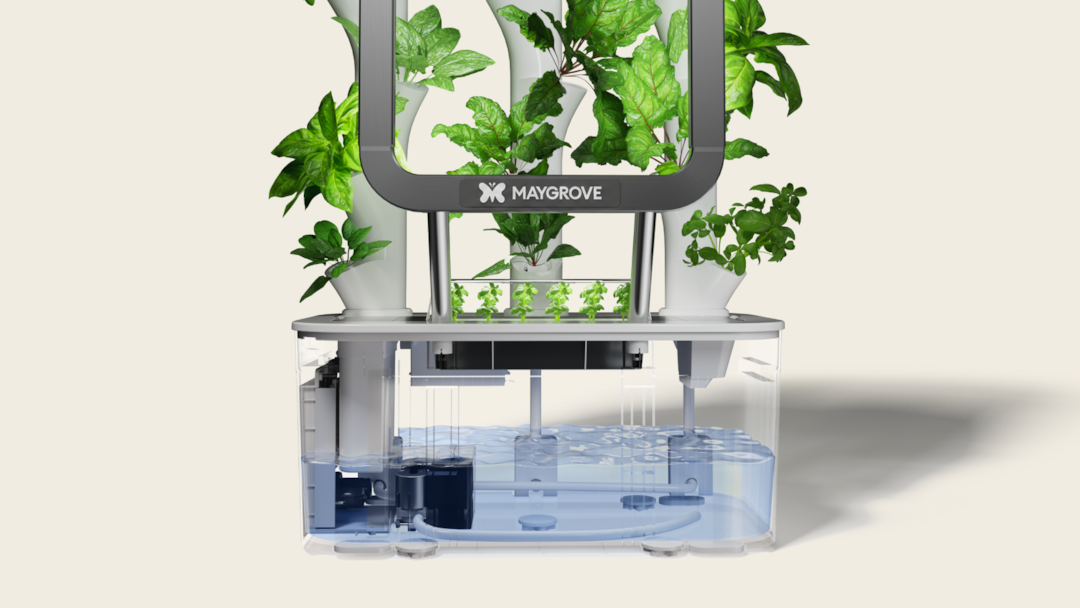
- Airflow is engineered, not natural. There is no breeze moving through a living room. Whatever air movement your plants get comes from the system's design—this is one reason the Verti 30 includes built-in airflow as a feature rather than an afterthought.
If you are new to how these systems work at all, how a hydroponic garden works walks through the mechanics first.
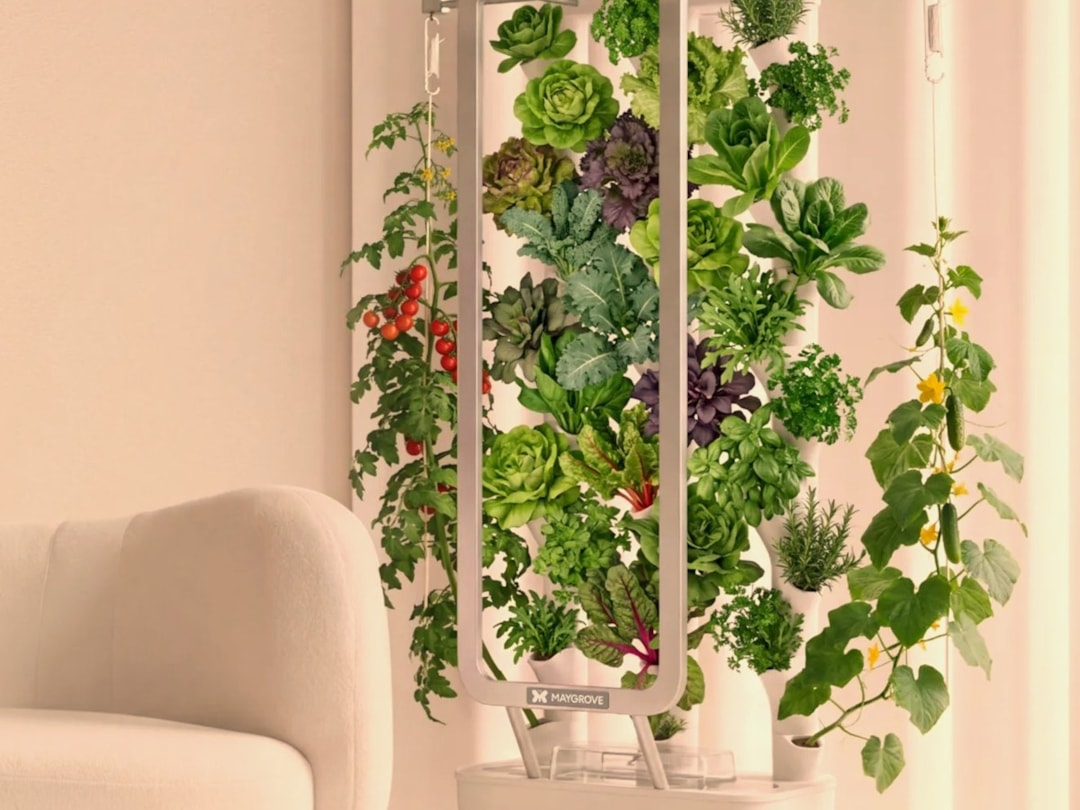
What Happens When Plants Are Too Close Together?
Insufficient spacing leads to a predictable chain of problems, and they compound each other:
- Uneven light exposure. Taller or faster-growing plants shade smaller neighbors. Research from Virginia Tech Extension notes that plant-to-plant shading changes light quality itself, triggering hormones that make shaded plants stretch—producing pale, leggy stems instead of compact growth. This is the same reason indoor herbs grow slowly when conditions are off.
- Stagnant, humid air. Dense foliage slows air movement around leaves, and leaves that stay damp for hours are the classic precondition for fungal problems. University extension guides for greenhouse growers treat wider spacing as a disease-prevention tool for exactly this reason.
- Difficult harvesting. Overlapping stems make it harder to reach mature leaves without damaging neighbors—and awkward harvesting leads to skipped harvesting, which leads to more crowding.
- Competition for resources. In a shared reservoir, every extra plant adds demand for water, oxygen, and nutrients. A crowded tower is a system running closer to its limits.
- Weaker plants overall. Leggy growth, fewer usable leaves, and poorly shaped canopies are the end result of all of the above.
One honest caveat: crowding is only one possible cause of struggling plants. Yellowing leaves, for instance, can point to nutrients, lighting, temperature, or root health instead. Before you rip plants out, work through what yellow leaves in a hydroponic garden actually indicate.
What Determines How Much Space a Plant Needs?
Four attributes of the mature plant—not the seedling you plug in—decide how much room a crop really needs.
Mature Canopy Width
A young lettuce plant fits anywhere. Eight weeks later, its leaves may span 8–12 inches. Kale and Swiss chard grow broader still, and fruiting plants spread through branching stems. Plan for the canopy the plant will have, not the one it has.
Mature Height
Height matters in a vertical garden because every plant casts a shadow down the tower. A full-size tomato filling a side trellis can dim the sites beside and beneath it as it climbs. Compact and dwarf varieties exist precisely to solve this problem.
Root Habit
Hydroponic roots share a reservoir, so they don't fight over soil territory—but vigorous plants still develop larger root masses, and extremely crowded root zones can interfere with each other and with the system itself.
Days to Harvest
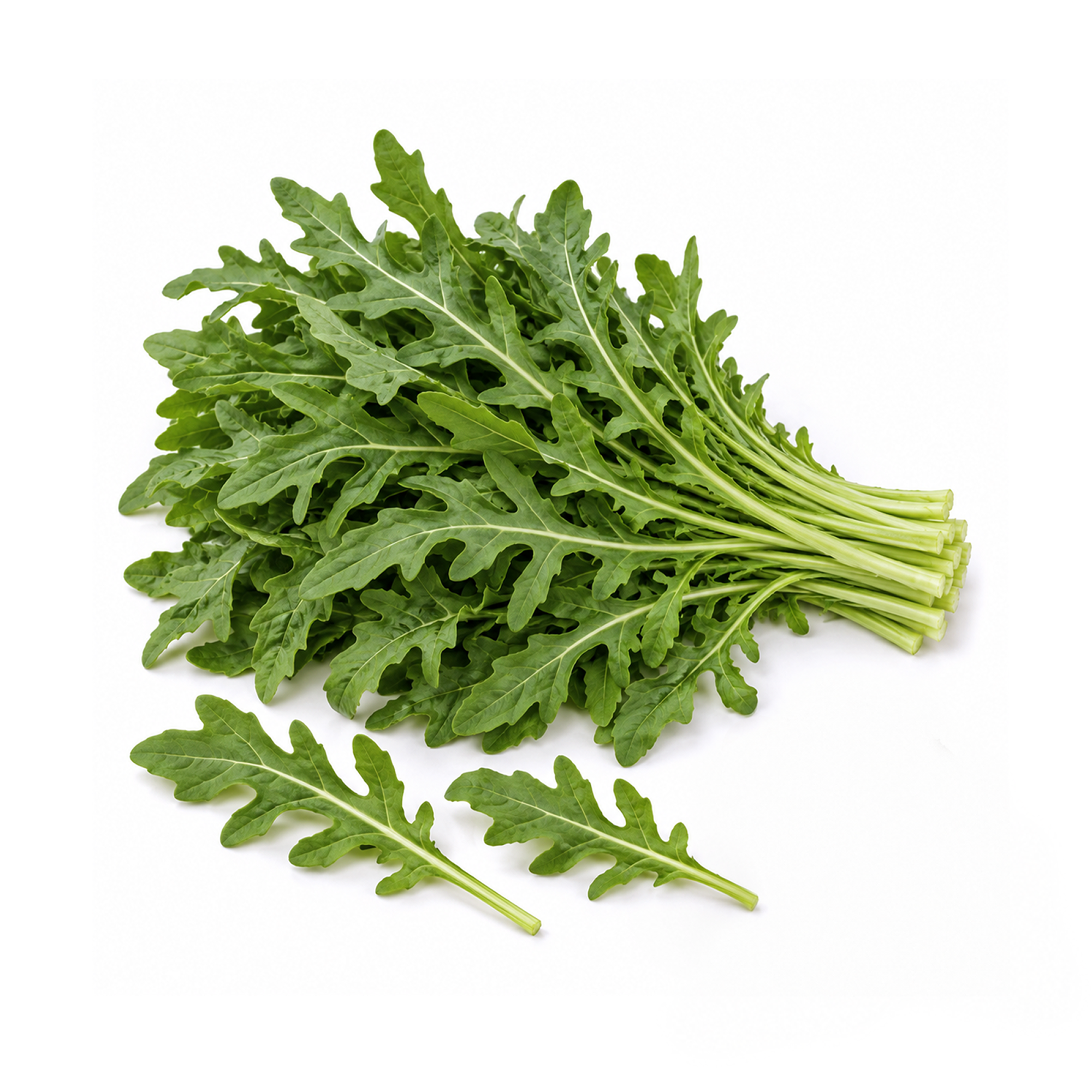
Fast crops (arugula, baby lettuce: 3–4 weeks) occupy a site briefly, so temporary crowding matters less. Slow crops (kale, tomatoes: 2–3 months or more) hold their space all season, so their mature size must fit from day one.
How Much Space Does Each Crop Need?
Soil-based spacing charts don't transfer directly to towers, but they are still the best starting point for estimating canopy size. The ranges below combine standard extension spacing recommendations with container-growing guidelines from Colorado State University Extension, which lists minimum container spacings such as 9 inches for leaf lettuce, 9–12 inches for chard, and 18 inches for cucumbers.
| Plant Type | Typical Canopy Need | Spacing Notes |
|---|---|---|
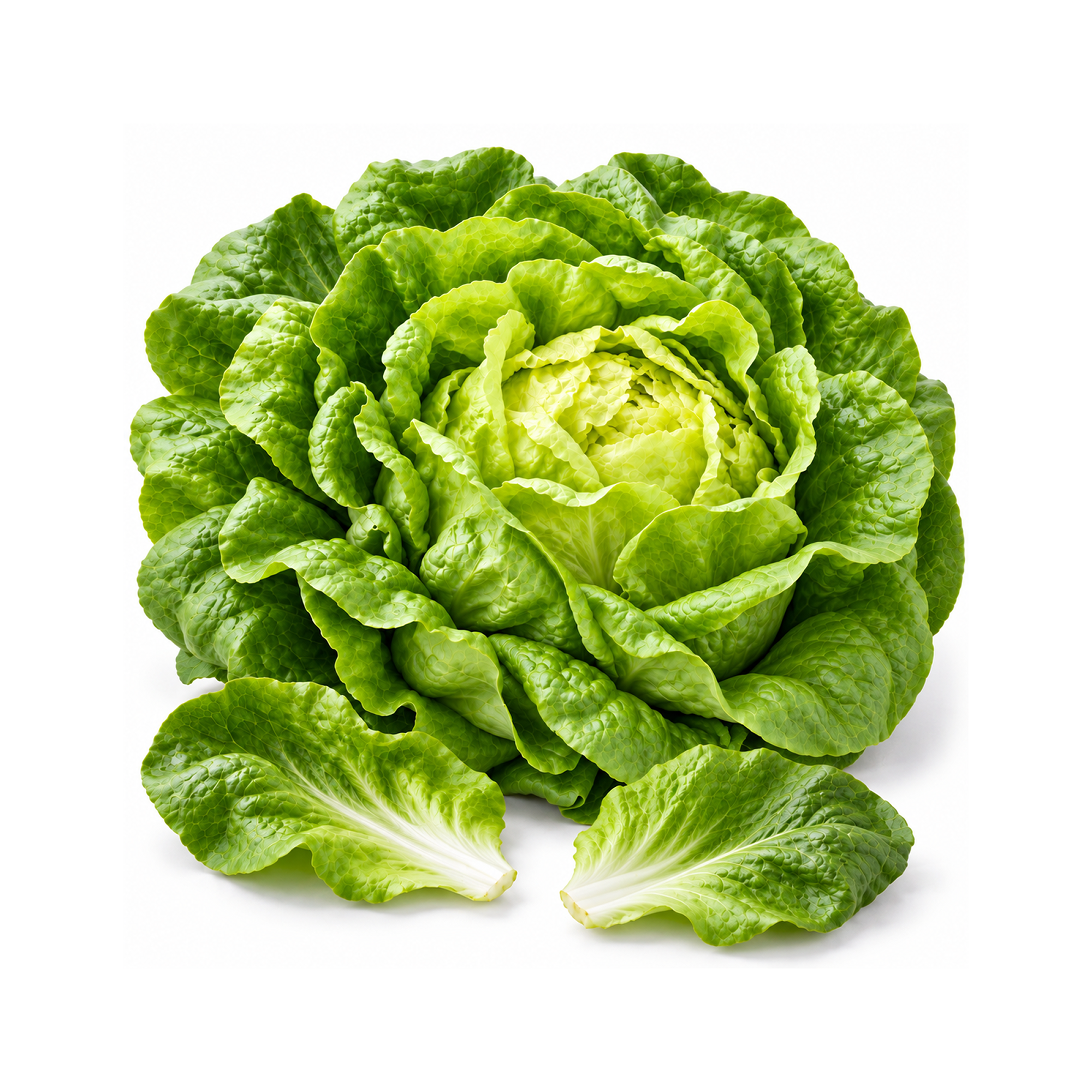
| Compact loose-leaf lettuce | 6–9 in | The most tower-friendly crop; continuous harvest keeps canopies small |
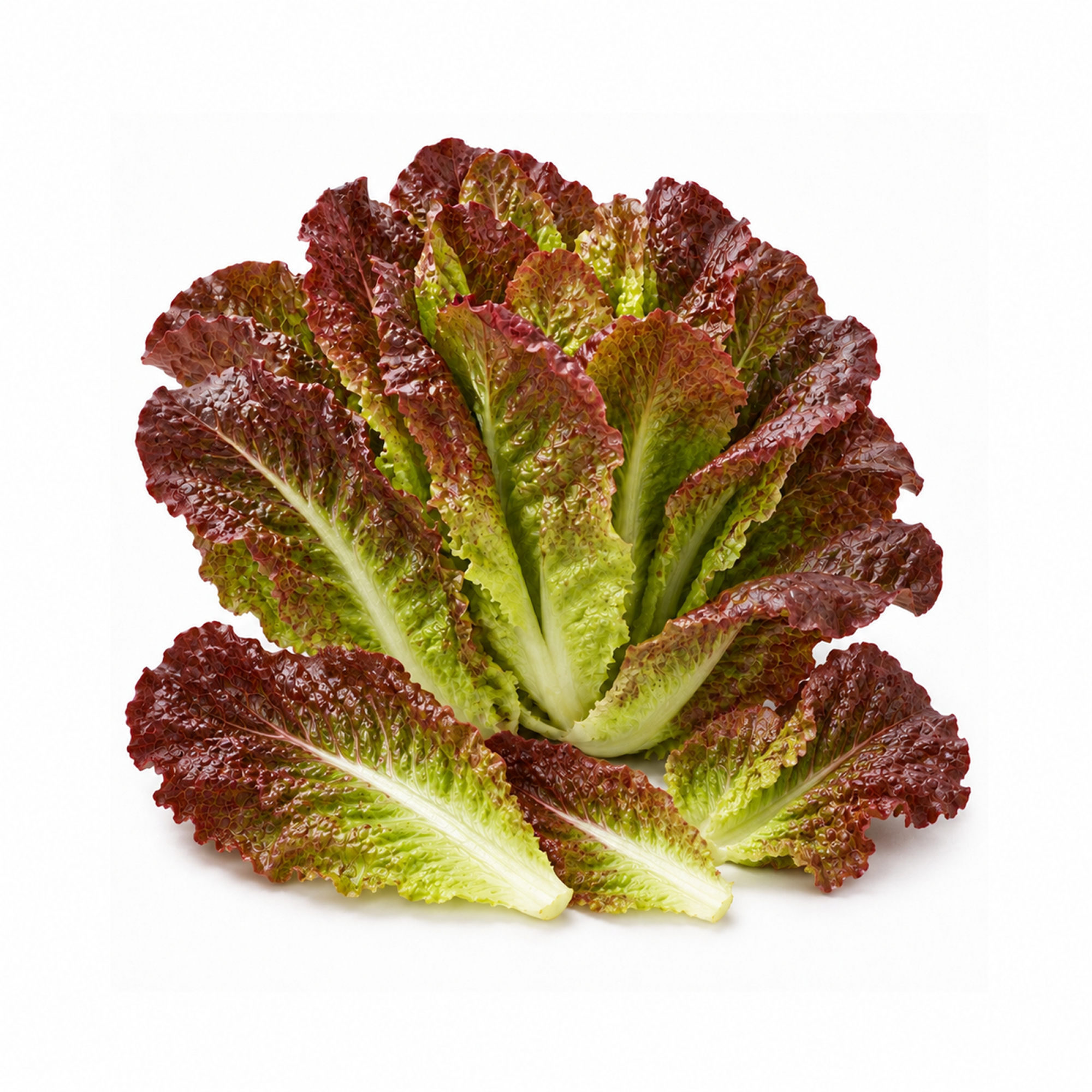
| Larger head lettuce (romaine, crisphead) | 9–12 in | One site each; romaine grows well indoors but sizes up |
| Basil and compact herbs | 6–10 in | Regular pinching keeps the canopy in bounds |
| Kale & Swiss chard | 10–18 in | Large leaves shade neighbors; leave a site empty beside each |
| Cherry/dwarf tomatoes | 12–24 in | Needs trellis support and strong light; see indoor pollination |
| Cucumbers | 18–24 in | Vining growth plus fruit; give it the trellis and real room |
| Peppers | 12–18 in | Branching canopy; dwarf varieties fit towers far better |
Utah State University Extension's vegetable planting guide is a good cross-check for any crop not listed here.
Read the table as canopy budgets, not instructions to measure the distance between cups. In a tower with fixed sites, the question is never "how far apart?"—it is "how many sites does this crop's canopy deserve?"
How Do Fixed Planting Sites Change the Spacing Math?
This is where vertical gardening inverts a piece of conventional wisdom—and where extension research is surprisingly useful.
Agronomists measure spacing two ways: yield per plant and yield per square foot. Virginia Tech Extension's plant density guide shows the tradeoff clearly: crowding reduces what each individual plant produces, but the extra plants can partly compensate, so total yield per area may hold up. Commercial growers optimize per square foot, because that's their limiting resource.
Your kitchen is not a farm, and your limiting resource is not square footage—it is how much food you actually want to eat each week, and how much care you'll give. Two conclusions follow:
- Yield per plant is what you eat. A tower with 25 thriving plants you harvest weekly beats 30 crowded ones you have to triage. When every plant is competing, everything matures slower and nothing gets big.
- The failure mode is different. On a farm, overcrowding shows up gradually in yield data. In a living room, it shows up as a damp, stagnant, tangled canopy—and the tower has no second row to expand into.
So in a fixed-site system, spacing becomes a subtraction decision. The Verti 30's 30 growing sites are not 30 mandatory plants; they are 30 seats, and some seats should stay empty depending on what you plant.
How Should You Lay Out Crops on a 30-Site Tower?
A workable layout follows a few placement rules, then accepts that some sites stay vacant.
The rules:
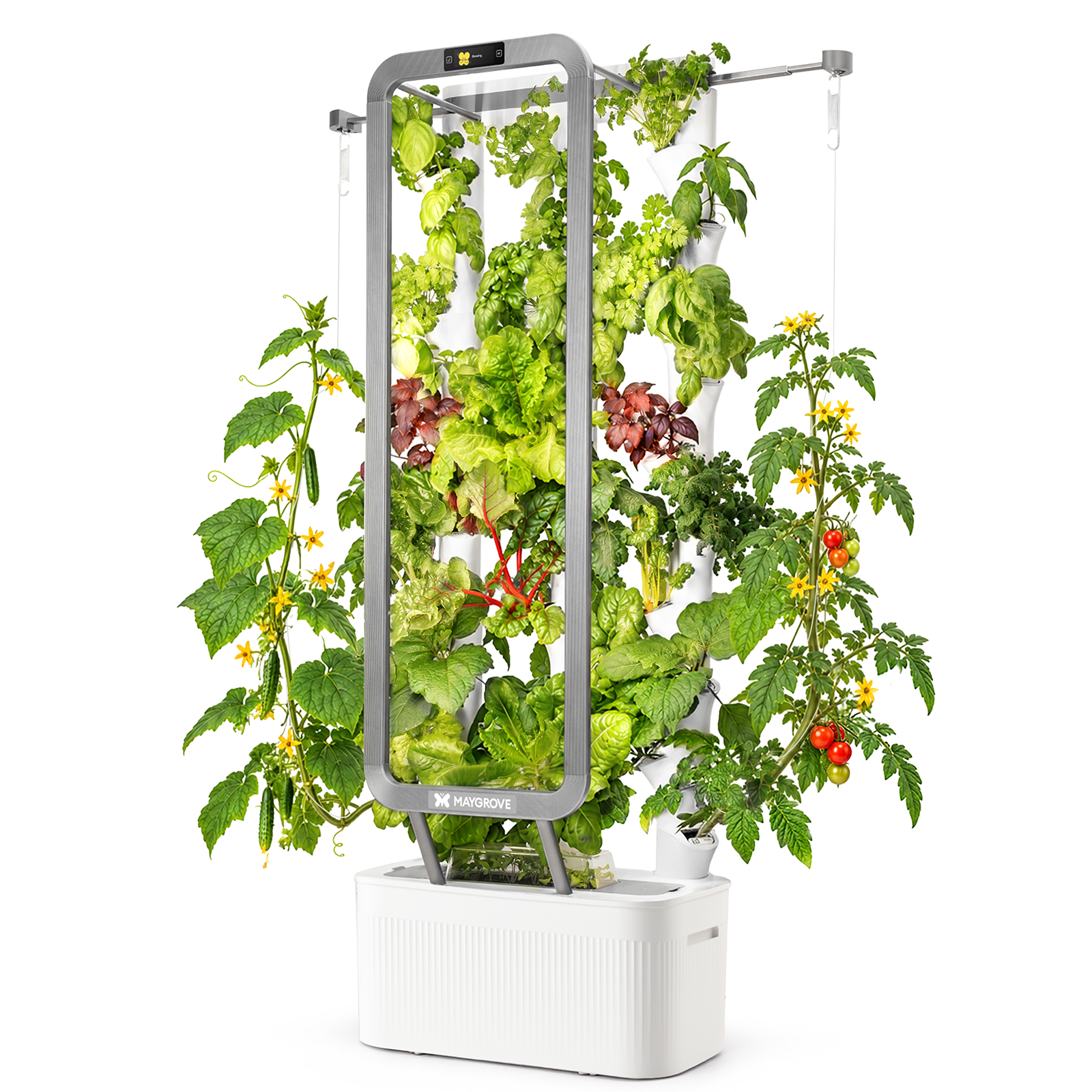
- Vining crops go in the bottom side sites—and there are only two. The trellis strings run up the left and right sides of the tower, so a vine wants the lowest site on its side: it starts near the base and climbs the string with the whole side of the tower to itself. One vine per side; two vining plants is the practical ceiling on a tower like this.
- Big canopies get a buffer. Kale, chard, and full-size lettuce deserve an empty neighbor. One skipped site buys more harvest than the plant you'd have squeezed in.
- Compact crops fill the middle. Lettuce, arugula, and basil tolerate closer quarters—this is where a tower earns its density.
- Stagger maturity. Mix fast and slow crops so something is always ready and sites free up progressively.
- Use the seedling module as a staging area. A 12-pod nursery module lets you start the next wave before the current one retires, so empty sites stay empty for days, not weeks.
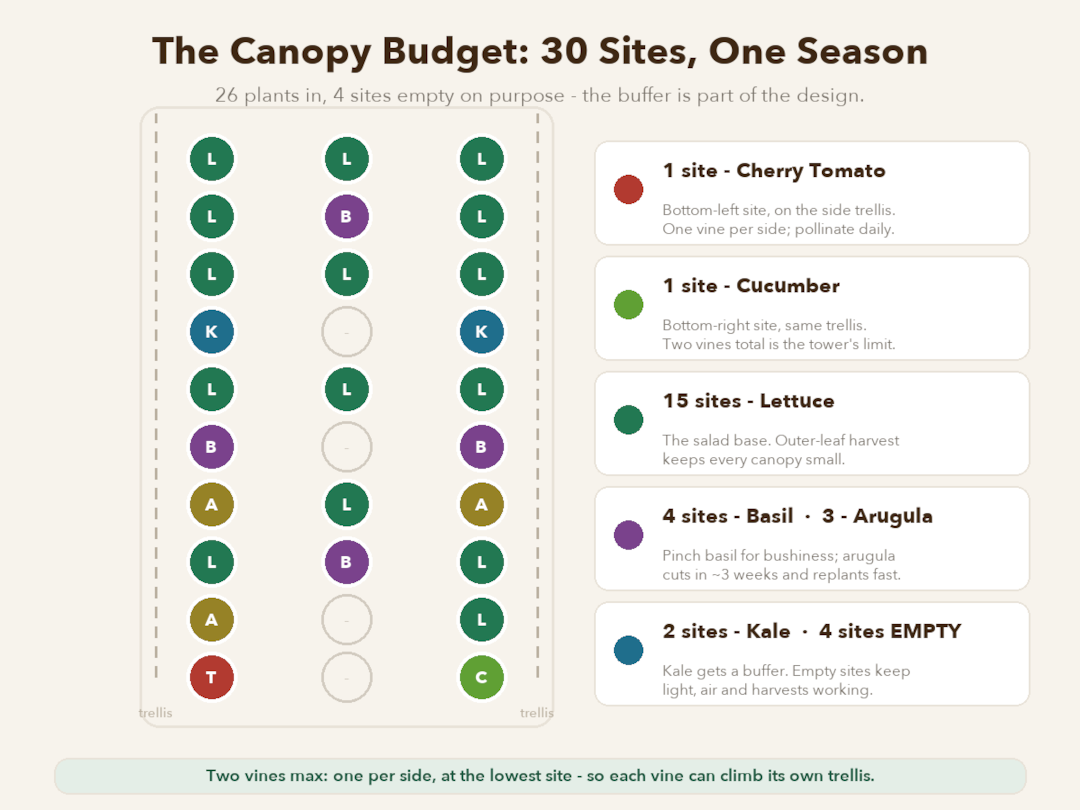
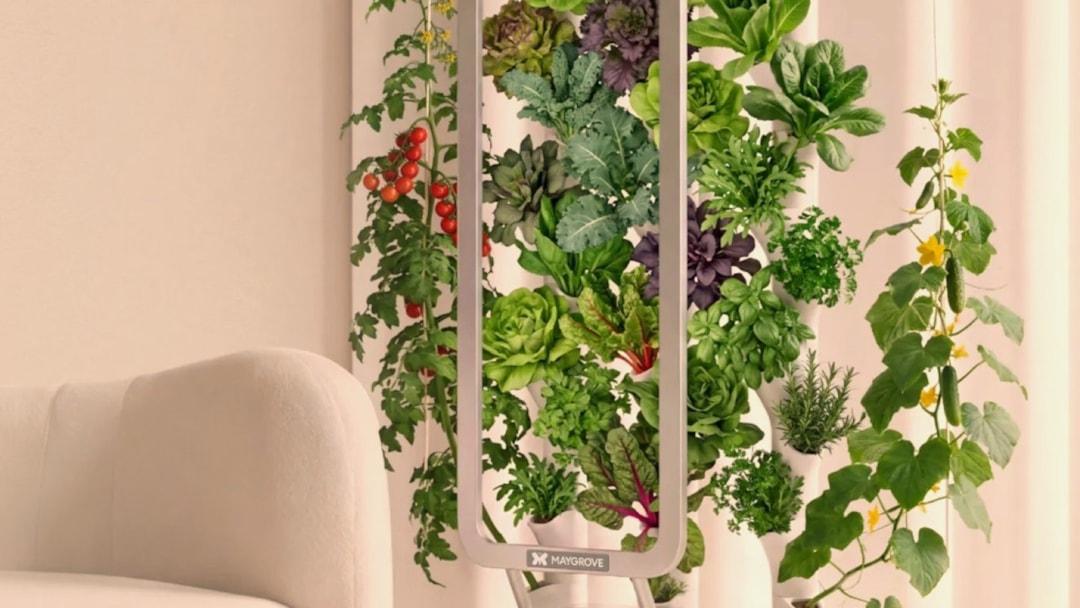
The example above uses 26 of 30 sites and leaves 4 empty on purpose. That's not wasted capacity—it's the buffer that keeps light, air, and harvesting working for the other 26.
How Do You Fix a Garden That Is Already Overcrowded?
Vertical gardens almost always look well spaced at week two and crowded at week six. The fix is a sequence of least-disruptive moves first:
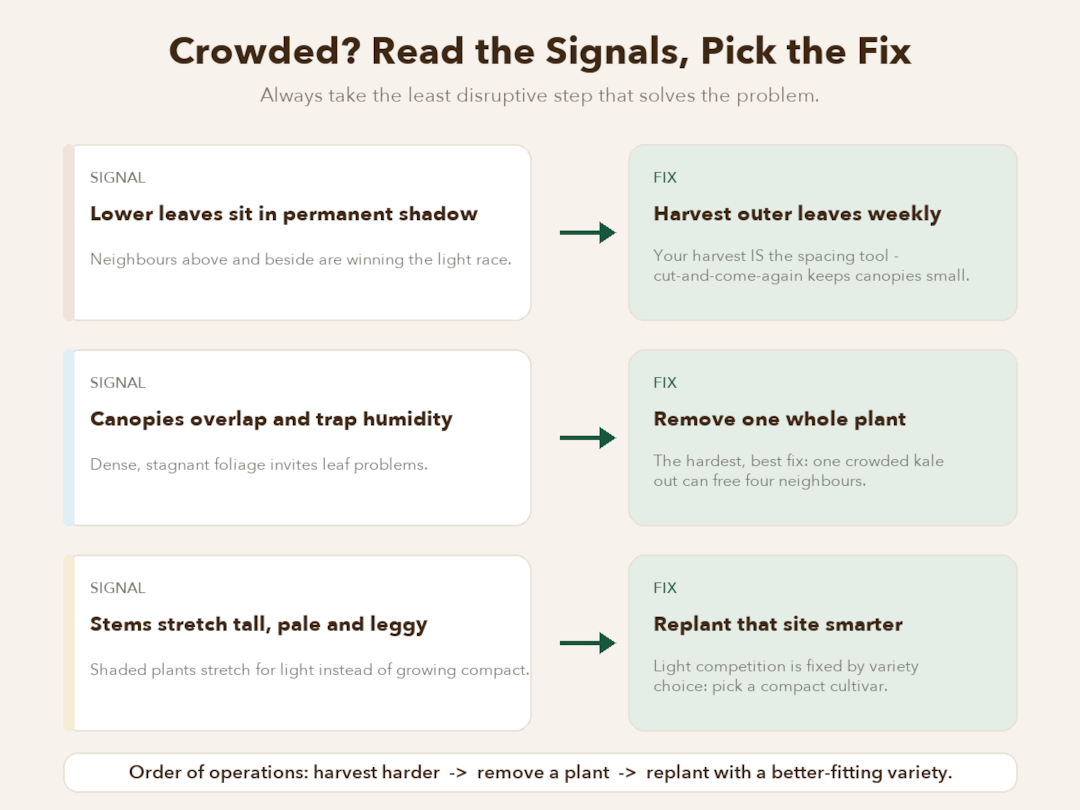
Harvest harder before removing anything. For lettuce, taking outer leaves regularly is both your harvest and your spacing tool—it keeps canopies small indefinitely. For basil, pinching above leaf nodes forces bushier, more compact regrowth.
Remove one whole plant when needed. This is the hardest instruction for beginners to follow and the most effective. Pulling one crowded kale that's shading four neighbors trades one plant for the health of the surrounding half-tower.
Prune honestly, not desperately. Tomatoes benefit from cultivar-appropriate pruning and training; cucumbers can be guided along their strings. But pruning cannot make an oversized crop fit a small space—never strip healthy leaves just to squeeze a plant in.
Thin seedlings on time. When multiple seeds sprout in one site, remove the weaker ones early, before the competition stunts all of them.
Replant smarter next round. If the same spot always ends up crowded, the cultivar was too big for the site—choose a compact variety or leave the site out of the next plan.
What Does Spacing Mean for Your Harvest Schedule?
Good spacing is really a promise about your future weeks. A well-spaced tower delivers a steady rhythm: a few heads of lettuce ready each week, herbs regrowing after each pinch, fruiting plants that ripen on schedule because light reaches the whole canopy.
A crowded tower delivers everything at once—or nothing, because everything is stunted. If you grow lettuce, the cut-and-come-again harvesting method is the single best spacing tool you have, keeping each plant's footprint small for months. If your ambitions run to fruiting crops, remember they also ask for daily attention during flowering—see how to pollinate tomatoes, peppers, and cucumbers indoors—so their site count should stay modest enough that daily care stays realistic.
Is the Maygrove AI Growbot Verti 30 Built for Tight Spaces?
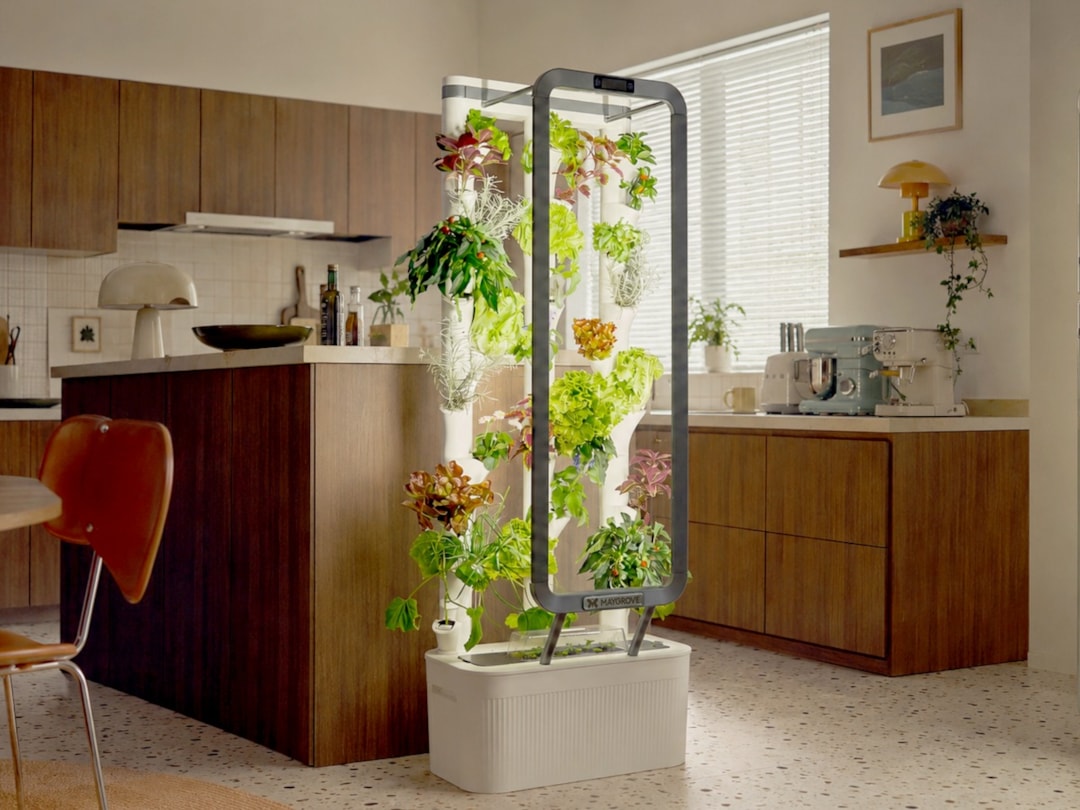
The Verti 30 packs 30 growing sites plus a 12-pod seedling module into a 23.8 × 15.8 inch footprint, with five-meter retractable trellising strings on each side—room for one climbing plant per side, which is why two vines is the practical ceiling. The fixed site spacing is deliberately tight for leafy greens—its natural density—and the design assumes you'll manage spacing the way this guide describes: compact varieties in most sites, vining crops on the strings, buffers where big canopies need them, and empty seats as part of the plan.
Its what can you grow in an indoor garden crop menu pairs well with this layout logic. And Mavi, the built-in AI gardening assistant, helps with exactly the decisions in this article: it guides plant placement, estimates germination timelines, sends harvest reminders, and flags crowding-related stress early. If you are comparing systems, the honest question to ask is not "how many sites?" but "does the system help me match crops to sites over a whole season?"—because that, more than site count, is what spacing success looks like.
Frequently Asked Questions
How Many Plants Can I Grow in a Vertical Garden?
It depends on the system's number of planting sites, the crops you choose, and their mature size. A 30-site tower might comfortably hold 20–26 mature plants in a mixed plan: 12–14 lettuce, 4–6 herbs, 2 vining crops (one per side trellis), and a few intentionally empty sites around large canopies. The site count is a ceiling, not a quota.
Can I Grow Lettuce and Tomatoes Together in a Vertical Garden?
Yes, if the system supports both and you place them thoughtfully. Tomatoes need strong light, trellis support, and hand pollination; lettuce tolerates less light but suffers if shaded heavily. Give the tomato the lowest site on one side so it can climb that side's trellis string, keep the lettuce in the open sites above and across, and plant only one vine per side—a tower's two side trellises support two vines in total, so everything else stays compact.
Do Plants Need Less Space in Hydroponics Than in Soil?
Not necessarily. Roots share a reservoir instead of competing for soil territory, which helps, but canopies still need their light and air. Treat hydroponic spacing as canopy management, not root spacing, and follow your system's crop recommendations.
Can I Use Every Planting Site in a Vertical Hydroponic System?
Not always, and often you shouldn't. Large crops may deserve two sites' worth of canopy, and some openings are better left empty to preserve airflow and light for their neighbors. Filling every site is the most common spacing mistake tower growers make.
Should I Leave Some Planting Sites Empty?
Yes—deliberately. Empty sites are buffers that keep light reaching lower plants, air moving through the canopy, and mature produce reachable for harvest. A 10% buffer (3 empty sites on a 30-site tower) is a sensible default for mixed plantings.
How Many Tomato Plants Can a Tower Support?
Two at most—one per side trellis. Each vine starts at the lowest site on its side and climbs the string, so a typical plan is one cherry tomato plus one cucumber, or two compact tomato plants. Cherry and dwarf varieties are the practical choice; full-size indeterminate tomatoes generally outgrow tower sites unless the system is explicitly built for them.
Can I Prune Instead of Spacing Plants Out?
Pruning manages a plant; it cannot replace spacing. Tomatoes, cucumbers, and basil all respond well to appropriate pruning and training, but removing healthy foliage just to fit an oversized crop into a tight site weakens the plant and usually fails anyway. Choose a suitably sized cultivar instead.
What Happens if I Plant Too Close Together?
Expect a chain reaction: lower leaves get shaded, shaded plants stretch into leggy growth, dense foliage traps humidity against the leaves, harvesting becomes awkward, and overall yields drop. None of it is instant, which is why crowding goes unnoticed until week six.
What Can I Grow in a Seedling Module While the Tower Is Full?
Fast, compact crops: lettuce, arugula, basil, and similar greens. A 12-pod seedling module works best as a nursery—start the replacement wave there, then rotate it into tower sites as older plants retire. This keeps every transition gap short.
Does Crowding Affect Flavor or Nutrition?
Indirectly, yes. Crowded plants get less light per leaf, which slows growth and can reduce the sugar and nutrient accumulation that makes homegrown produce taste good. Crowding doesn't make plants unsafe or empty—but well-spaced plants are simply growing at their full potential.
The Bottom Line
Plant spacing in a vertical garden is not a distance you set—it is a budget you allocate. Each crop's mature canopy, height, and root habit determine how many fixed sites it deserves, and the discipline of leaving sites empty is what keeps light, airflow, and harvesting working for every plant you did plant.
Start with compact varieties, keep vines to the two side trellises, harvest aggressively, and treat empty sites as part of the design rather than wasted capacity. Do that, and a 30-site tower will out-harvest any window of crowded plants—because in gardening, as in most things, the goal is not to maximize what you put in, but what you get out.